Phone:
(701)814-6992
Physical address:
6296 Donnelly Plaza
Ratkeville, Bahamas.
Phone:
(701)814-6992
Physical address:
6296 Donnelly Plaza
Ratkeville, Bahamas.
Calculate exactly how much decorative rock, gravel, or stone you need for your landscaping project.
Total length of the bed or driveway.
Total width of the area.
Larger rocks require deeper coverage to hide the soil.
Impacts the final tonnage.
Check local quarries for bulk pricing.
Required Material
2.5
Total Tons
1.85
Cubic Yards (yd³)
Total Area
300 Sq Ft
Estimated Cost
$162.50
Your feedback helps us build better tools.
A Rock Coverage Calculator converts the square footage of your landscaping beds or driveway into cubic yards and tonnage, allowing you to accurately order bulk rock, gravel, or stone from a quarry or landscape supply center.
Different types of rock have different densities. This tool adapts to your specific material by factoring in the unique weight profile of your chosen stone, helping you order the correct tonnage to achieve your desired depth.
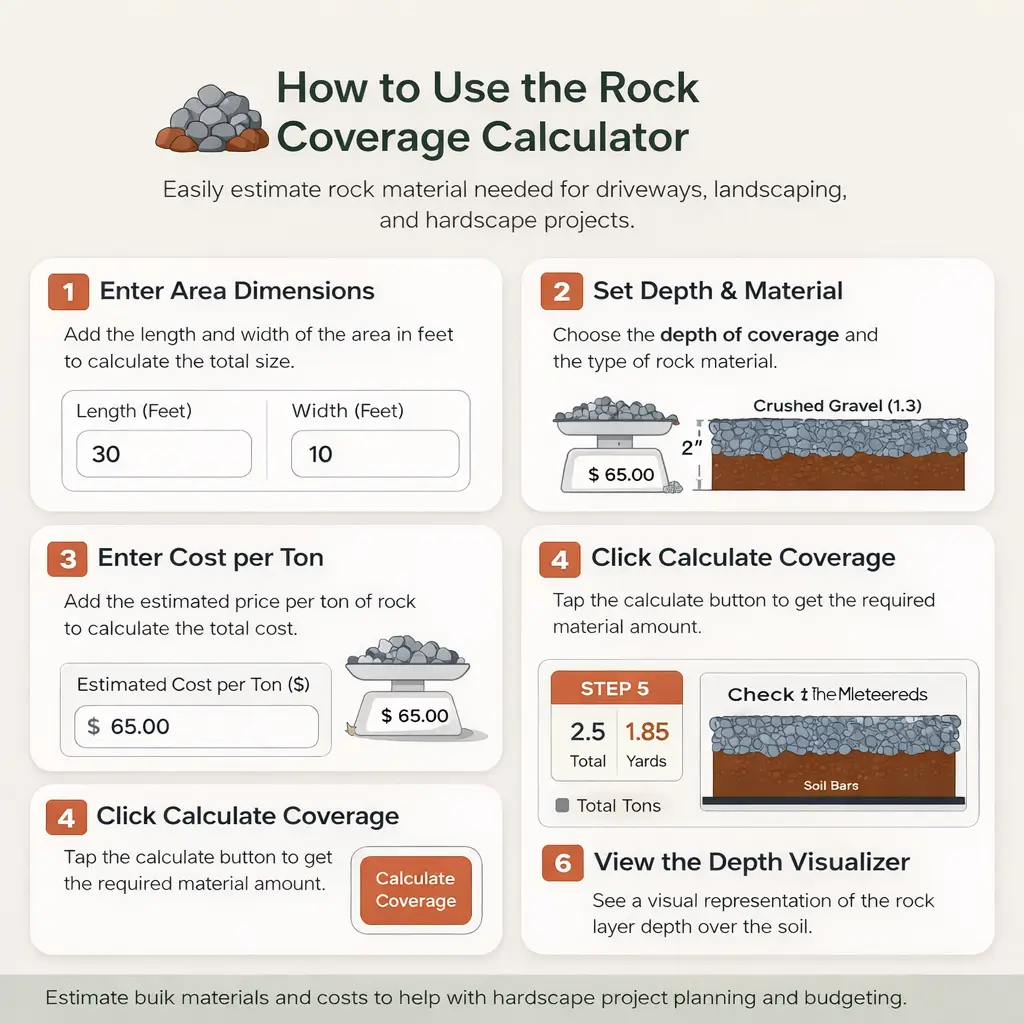
Follow these simple steps to estimate your landscaping rock needs:
From empty beds to perfect coverage.
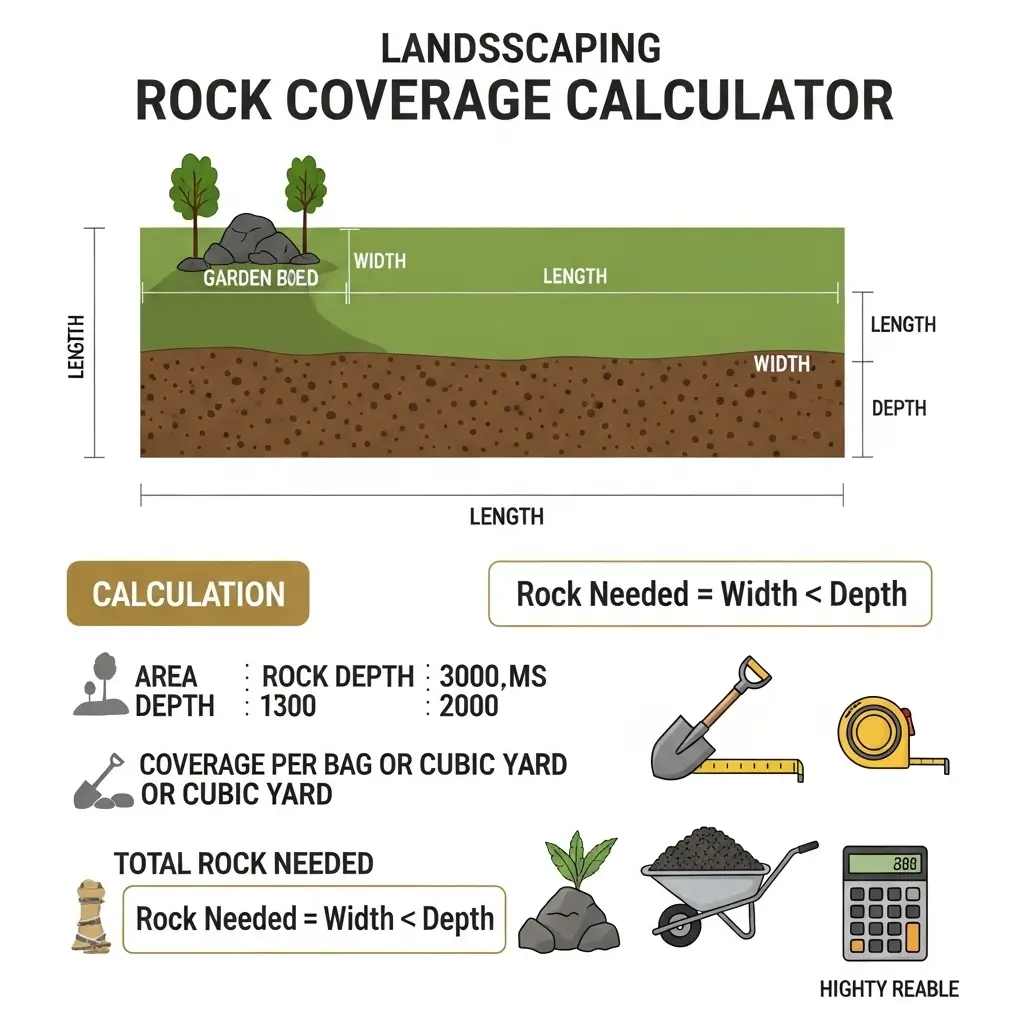
Determine the square footage by multiplying the length by the width. For complex curves, break the yard into smaller squares or circles and add them together.
Smaller rocks (like pea gravel) only need about 2 inches of depth to fully hide the soil. Larger rocks (like 2-3" river stones) need at least 3 to 4 inches of depth.
Identify the type of rock you are buying. Nurseries usually sell by the "Yard" (volume) but quarries often weigh your truck on a scale and charge by the "Ton".
Converting a flat measurement into a three-dimensional volume is step one. Converting that volume into weight requires knowing the density of your chosen stone.
Always order about 5% to 10% more rock than your exact calculation. Subgrades are rarely perfectly level, and having a tiny bit extra prevents you from having to pay a $100 delivery fee for a half-yard shortage.
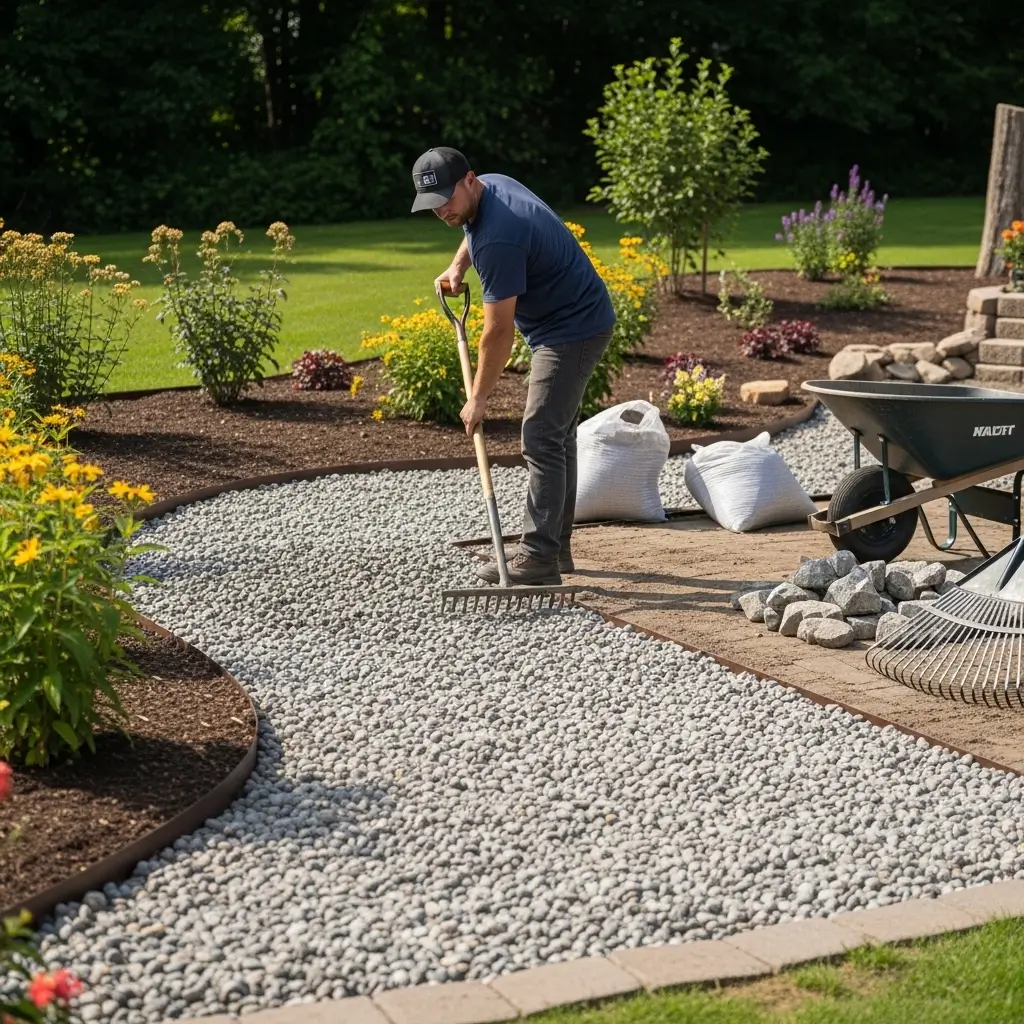
A common mistake homeowners make is buying large stones (like 2" to 4" river rocks) but only calculating enough volume for a 2-inch depth.
If the rocks themselves are 3 inches round, a 2-inch depth calculation will leave massive gaps where the underlying soil and weed-barrier fabric shows through. As a general rule: Your minimum depth must be at least 1.5 times the size of your largest rocks to achieve total visual coverage.
For small pea gravel, 2 inches is sufficient. For standard 1-2 inch river rock, plan for a 3-inch depth. For larger stones over 2 inches, plan for at least a 4-inch depth so the weed fabric is fully hidden.
River rock is very dense and typically weighs around 2,800 pounds (1.4 tons) per cubic yard. It is heavier than standard crushed gravel due to the lack of porous voids.
Standard bags of landscape rock from a big-box store hold 0.5 cubic feet. Since there are 27 cubic feet in a cubic yard, you would need exactly 54 bags to equal one cubic yard.
Yes. Commercial-grade, woven landscaping fabric is highly recommended under rock. Not only does it prevent weeds from growing up from the soil, but more importantly, it prevents the heavy rock from slowly sinking into the mud over the years.
Pea gravel is universally considered the best choice for dog runs. It is small, rounded, and smooth, so it won't cut their paws like crushed stone, and it allows urine to drain freely.
Find the radius (half the distance across the circle) in feet. Multiply Radius × Radius × 3.14. Take that final square footage number and enter it into the Width input, and enter "1" into the Length input of the calculator.
Yes, especially for smaller stones like pea gravel. Without a physical barrier (like a trench, brick border, or plastic edging), rock will constantly spill out into the lawn and get caught in your mower.
No, one cubic yard is always one cubic yard of physical volume. However, larger rocks leave larger air gaps between them. So while the volume is the same, you must lay large rocks deeper than small rocks to achieve total ground coverage without seeing through the gaps.
Jason T.
Homeowner
"Great tool! Put in my bed dimensions for river rock and the tonnage matched the quarry estimate perfectly. Barely had a wheelbarrow left over."
Sarah B.
DIYer
"Okay tool, but I had to manually calculate the square footage for my circular firepit area before I could use the simple length x width inputs."
Derek L.
First-time Buyer
"The yards calculation is correct, but my local place uses a different density multiplier for lava rock, so the tonnage was slightly off."
Amanda P.
Weekend Warrior
"Very helpful visualizer! It really clarifies why you need to go thicker with large rocks."
Tom R.
Estimator
"Nice visualizer. Saved me from ordering way too many arborvitaes for the edge of the property line."
Brian G.
Landscaper
"Easy to use. Exactly what I needed to quickly quote a landscaping job without doing the math by hand."
We'd love to hear from you! If you have suggestions, questions, or just want to say hello, please get in touch.