Phone:
(701)814-6992
Physical address:
6296 Donnelly Plaza
Ratkeville, Bahamas.

Phone:
(701)814-6992
Physical address:
6296 Donnelly Plaza
Ratkeville, Bahamas.
Calculate exactly how many cinder blocks and bags of mortar you need for your masonry wall project. This easy-to-use, highly valuable tool provides an easy-to-read breakdown of your materials and budget.
Includes standard 3/8" mortar joint allowance.
Total Blocks Needed
0
Total Block Cost: $0.00
Wall Area
0 ft²
Mortar (Bags)
0
Rows (Courses)
0
Blocks/Row
0
Your feedback helps us build better tools.
A concrete block wall calculator is an essential planning tool for any masonry project. Whether you are building a retaining wall, a foundation, or a privacy fence, this tool acts as a comprehensive block wall COST calculator to compute the total materials and budget required. It takes the guesswork out of material ordering, saving you time and avoiding mid-project hardware store runs.
By functioning as a block wall calculator number of blocks finder, it precisely maps out your structural needs for any custom dimensions.
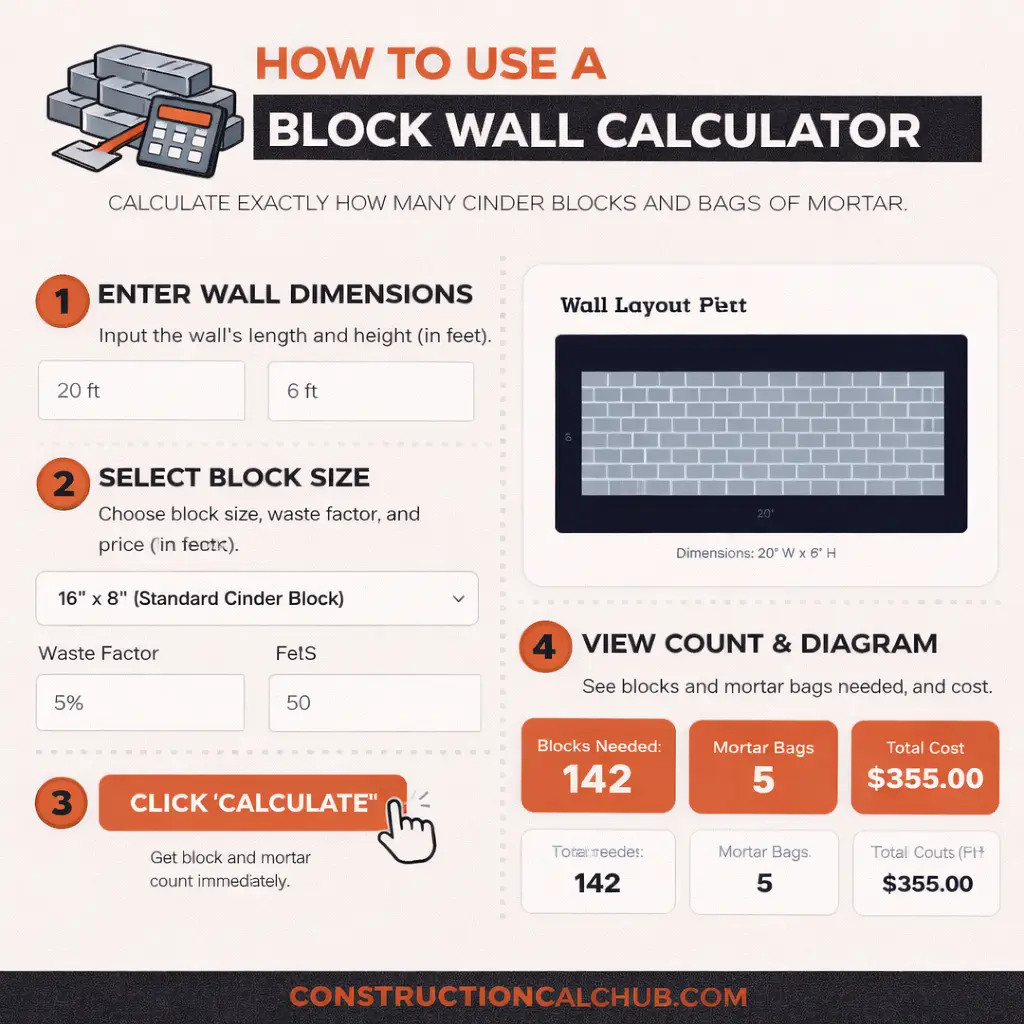
Follow these simple steps to estimate your block wall needs:
From measurements to materials.
Enter the total length and height of your planned wall in feet. Perfect for any landscape block wall calculator layout.
Choose your block dimensions. This 8 inch block wall calculator uses standard 16" long by 8" high dimensions by default.
Add a 5-10% waste factor for broken blocks or complex cuts in your cinder block wall calculator project.
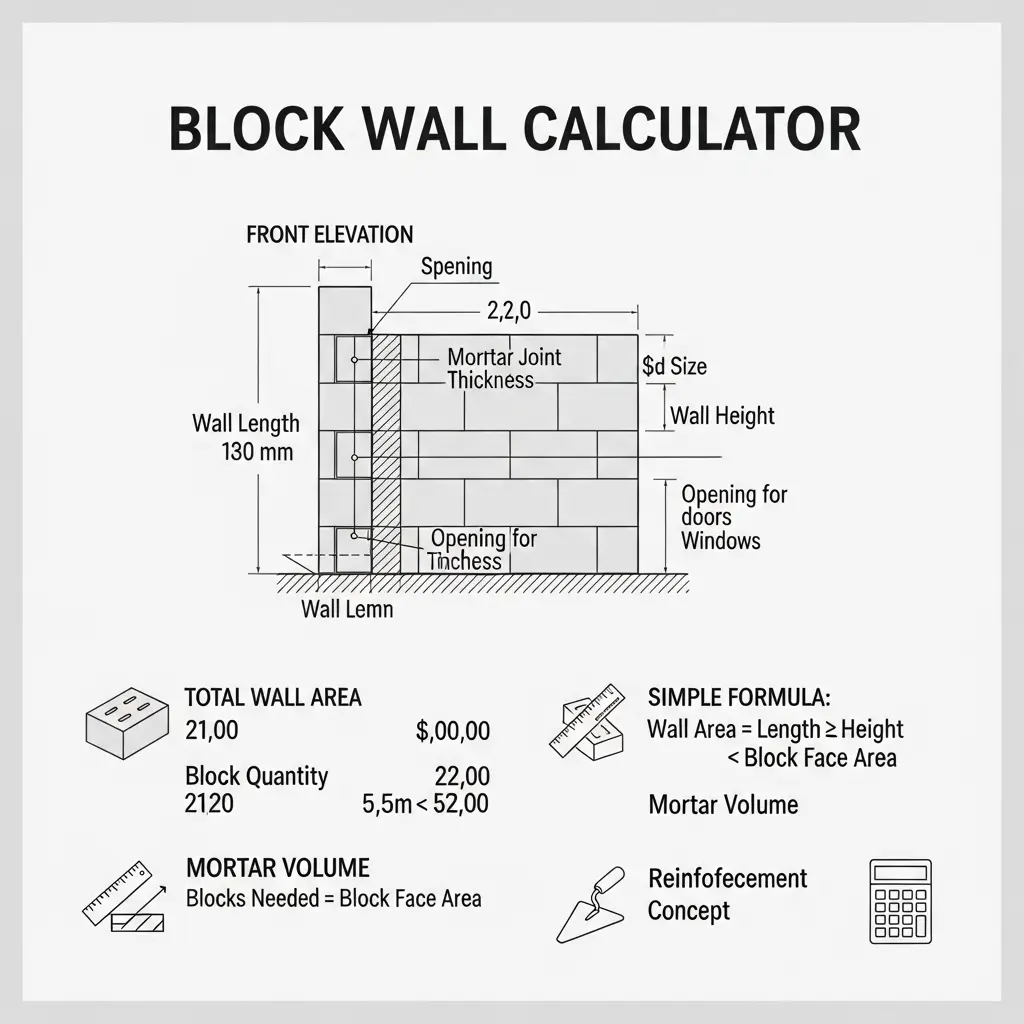
The formula assumes a standard 3/8" mortar joint between blocks. Therefore, a nominal 16x8 block actually takes up exactly 16x8 inches of wall space once installed.
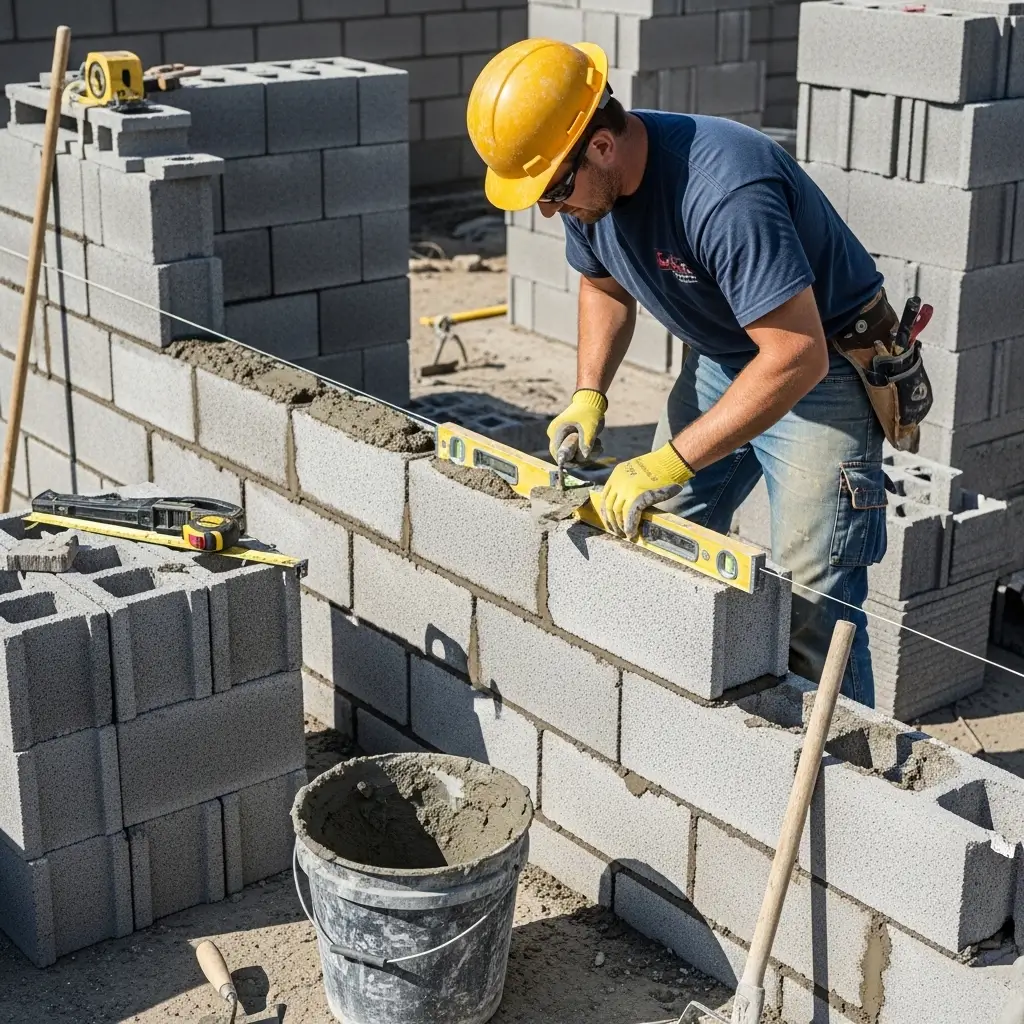
A common mistake when using a cement block wall calculator is miscalculating the mortar. As a general rule of thumb, one 80lb bag of pre-mixed Type S or Type N mortar will lay roughly 35 to 40 standard 8-inch blocks.
If your wall requires filling the cores with concrete or adding rebar (which is necessary for load-bearing or retaining walls), you will need to calculate core fill concrete separately.
The most common standard cinder block in the US is the "8-inch block." Its nominal size is 16" long x 8" high x 8" deep. Its actual dimensions are 15 5/8" x 7 5/8" x 7 5/8" to allow for a standard 3/8" mortar joint.
For a standard 16" x 8" concrete block, it takes exactly 1.125 blocks to cover one square foot of wall area. You can find this by dividing 144 square inches by the face area of the block (128 sq inches).
A general rule of thumb is that one 80-pound bag of pre-mixed mortar will lay about 35 to 40 standard 8-inch blocks. This assumes a standard 3/8-inch mortar joint.
Yes, but our calculator does this for you! Block sizes are "nominal," meaning a 16x8 block is actually slightly smaller, but when laid with a 3/8" mortar joint, it occupies exactly 16x8 inches of wall space.
A waste factor accounts for blocks that break during shipping, blocks you have to cut to fit ends or corners, and general mistakes. A 5% to 10% waste factor is standard for most masonry projects to ensure a safe calculation.
Yes, dry-stack block walls exist. They use a surface bonding cement (a fiberglass-reinforced stucco applied to the outside of the wall) rather than mortar between joints. The block count calculation remains essentially the same.
If the wall is load-bearing, a retaining wall over 2 feet high, or in a high-wind/seismic zone, rebar and concrete core fill are almost certainly required by code. Always consult local building codes.
A standard 8" x 8" x 16" heavyweight concrete masonry unit (CMU) weighs about 38 to 40 pounds. Keep this in mind when calculating transport; a pallet of 90 blocks weighs over 3,500 pounds!
Mike Davis
Masonry Contractor
"I use this for every job. It's spot-on for material orders and saves me from wasting money on extra pallets."
Sarah Mitchell
DIY Homeowner
"Good tool, but would love to see an option for hollow blocks vs filled blocks explicitly."
David Robinson
General Contractor
"Helpful for simple straight walls, but calculating retaining wall curves accurately still required some manual math."
Emily Reynolds
Landscape Architect
"Great for planning out backyard patios and retaining walls for clients. Helps me quickly create a budget."
John Larson
Property Manager
"I manage several rental units, and this calculator is essential for estimating masonry repairs for turnover. Simple and very accurate."
Kevin Miller
Retail Store Owner
"Used this for budgeting the new facade for my boutique. The estimate was incredibly close to my final cost."
We'd love to hear from you! If you have suggestions, questions, or just want to say hello, please get in touch.