Phone:
(701)814-6992
Physical address:
6296 Donnelly Plaza
Ratkeville, Bahamas.

Phone:
(701)814-6992
Physical address:
6296 Donnelly Plaza
Ratkeville, Bahamas.
Calculate blocks, capstones, and essential gravel. Use this complete retaining wall block calculator and retaining wall cost calculator for your next project.
Select the nominal size of your retaining wall blocks.
Total Blocks Required
0
Est. Block Cost: $0
Capstones
0
Rows (Courses)
0
Base Gravel
0 yd³
Backfill Gravel
0 yd³
Your feedback helps us build better tools.
A Retaining Wall Calculator is an essential planning tool for hardscaping projects. Unlike standard freestanding walls, retaining walls must hold back thousands of pounds of soil and water. Whether you need a heavy-duty concrete retaining wall calculator for a property boundary or a small-scale retaining wall fire pit calculator for a backyard gathering space, this tool determines structural blocks, capstones, and gravel volumes seamlessly.
From trench to capstone.
Measure the total length and the intended exposed height. The calculator automatically accounts for the buried base course.
Choose standard large (18") or medium (12") retaining wall blocks. This defines the square footage each block covers.
The tool automatically calculates the cubic yards of drainage gravel needed for a solid base and proper backfill.
Retaining walls require one row of blocks (a course) to be completely buried below grade. We add this automatically to your height input.
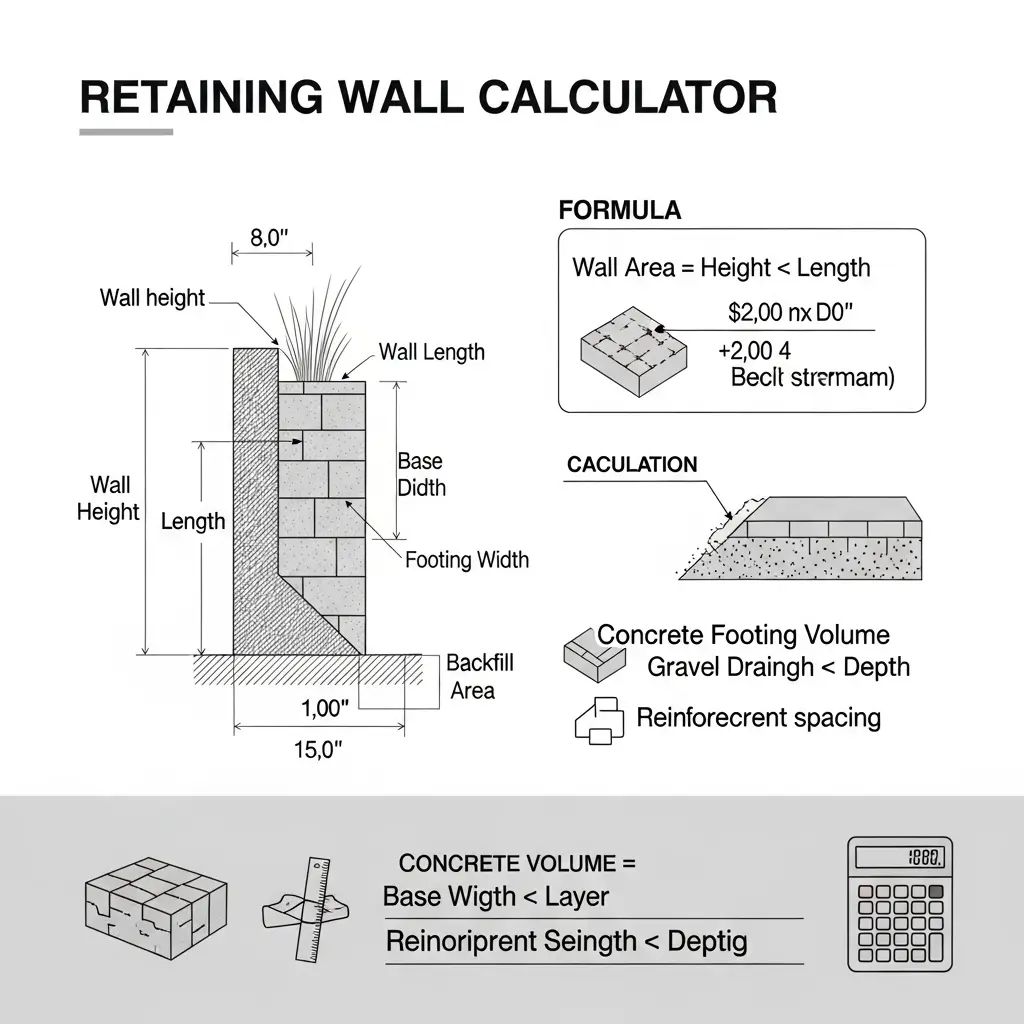
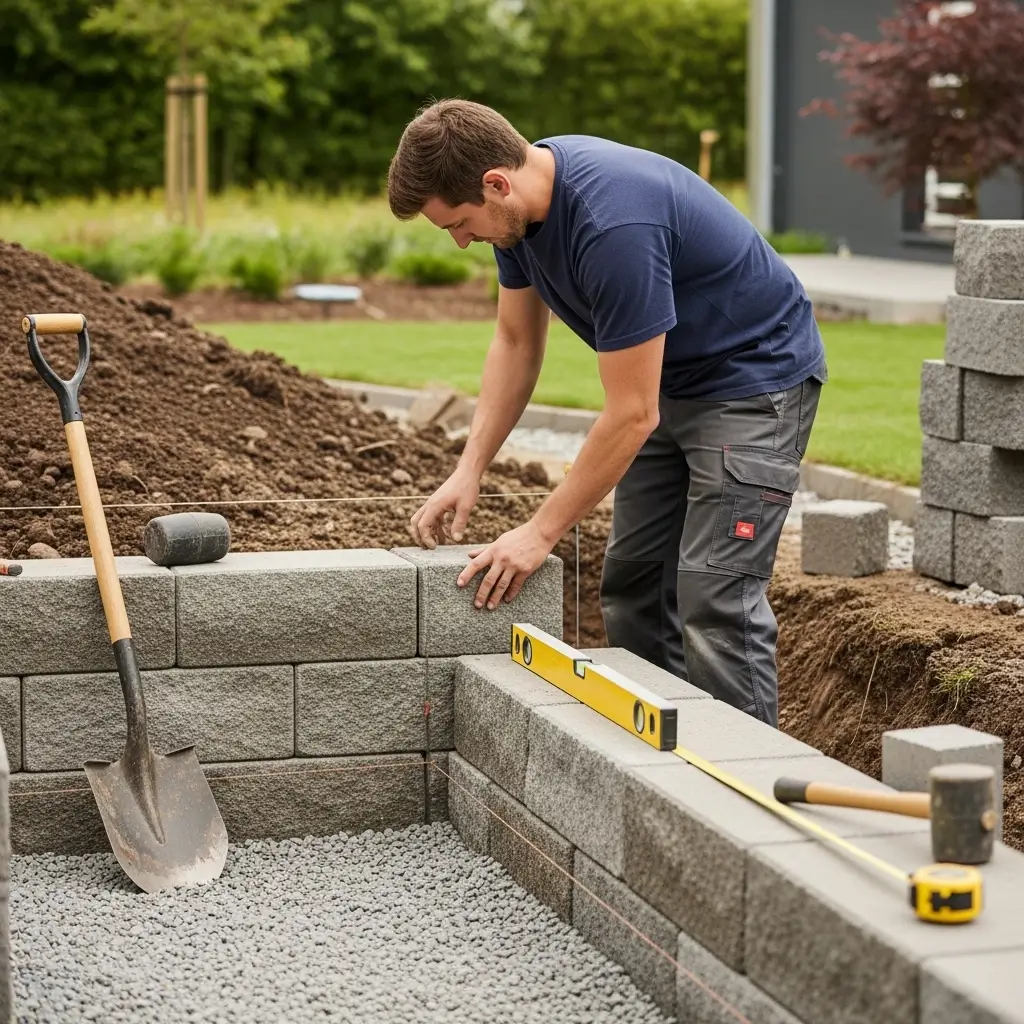
The #1 reason retaining walls fail is poor drainage and a weak base. While the blocks look nice, it's the hidden gravel that does the heavy lifting. That's why this tool doubles as a retaining wall footing calculator and retaining wall foundation calculator.
Base Gravel (Footing): A compacted 6-inch trench of 3/4" crushed stone provides a level, frost-resistant foundation.
Backfill: You must place at least 12 inches of clean crushed gravel directly behind the blocks. This allows hydrostatic pressure (water weight) to drain away instead of pushing your wall over.
Typically, the trench should be deep enough to hold 4 to 6 inches of compacted gravel base, plus half to a full block buried beneath the soil line for stability. So for a 6" high block, a 9-12" deep trench is common.
Yes, for almost all retaining walls. A perforated corrugated drain pipe (often sleeved in landscape fabric) should be laid behind the first course of blocks within the gravel backfill to direct water away from the wall.
It depends on the block size. A standard 18" long x 6" high block covers 0.75 square feet, meaning you need 1.33 blocks per square foot. A smaller 12" x 4" block requires exactly 3 blocks per square foot.
Setback (or batter) is the slight backward lean of the wall as it gets taller. Interlocking retaining wall blocks have a built-in lip or pin system that automatically creates this setback (usually 3/4" to 1" per course) to push back against the soil weight.
In most municipalities, walls over 4 feet tall (including the buried base course) require a structural engineer's design, which usually involves laying geogrid mesh into the soil behind the wall to stabilize the earth.
Best practice dictates at least 12 inches of clean, crushed angular stone (like 3/4" clear stone) directly behind the wall for the entire height. Our calculator estimates this volume in cubic yards.
Capstones sit on the very top row to give the wall a finished look. We divide the total length of the wall by the length of the selected block to find the linear capstones needed, plus your selected waste factor.
Yes! Modern Segmental Retaining Wall (SRW) blocks are designed to be "dry-stacked" without mortar. They rely on their own heavy weight, the interlocking pins/lips, and proper gravel backfill for structural integrity. You only need masonry adhesive for the top capstones.
James D.
Landscaper
"This is a great tool. Perfectly calculated the base gravel, saved me from an extra delivery fee."
Sarah M.
DIY Enthusiast
"Nice tool, but I wish I could add curved wall sections directly."
Tom R.
First-time Builder
"Helped me perfectly estimate my retaining wall. No leftover pallets to return."
Leo H.
Weekend Warrior
"Okay, but I miscalculated my mortar slightly. The gravel count was perfect though."
Emily R.
Architect
"Very useful visualizer. The buried base course logic is correct."
Lisa Peterson
Gardener
"This calculator helped me plan my garden terrace wall beautifully. Everything fit perfectly."
We'd love to hear from you! If you have suggestions, questions, or just want to say hello, please get in touch.