Phone:
(701)814-6992
Physical address:
6296 Donnelly Plaza
Ratkeville, Bahamas.

Phone:
(701)814-6992
Physical address:
6296 Donnelly Plaza
Ratkeville, Bahamas.
Plan your spiral stairs with precise rotation, headroom, and tread counts.
E.g., 9 feet = 108 inches.
Standard sizes are 42" to 72".
Rotation per step.
Required Treads & Riser Height
12
Total Treads
8.31"
Per Riser
Total Rotation
360°
Headroom Status
Passes
Your feedback helps us build better tools.
A Spiral Stair Calculator determines the precise geometry needed to safely navigate between floors using a space-saving radial design. It takes your floor-to-floor height and diameter to find the necessary number of treads, ensuring riser heights meet local building codes.
By determining the rotation angle, this tool also helps you understand exactly where you will enter the bottom of the stairs and where you will exit at the top floor, preventing awkward landing placements.
From empty space to a stunning staircase.
Measure the vertical distance from the finished floor of the lower level to the finished floor of the upper level in inches.
Ensure you have enough square footage. Most building codes require a minimum 60" diameter for the stairs to serve as a primary egress.
Review the total rotation angle (often around 360°) so that the entry step and exit landing line up naturally with your floorplan.
Standard spiral stairs rely on strict measurements to maintain safety while rotating around a tight radius. The International Residential Code (IRC) dictates specific maximums and minimums.
Unlike straight stairs, spiral stairs are permitted to have a steeper maximum riser height (up to 9.5 inches per IRC) due to the constraints of the design.
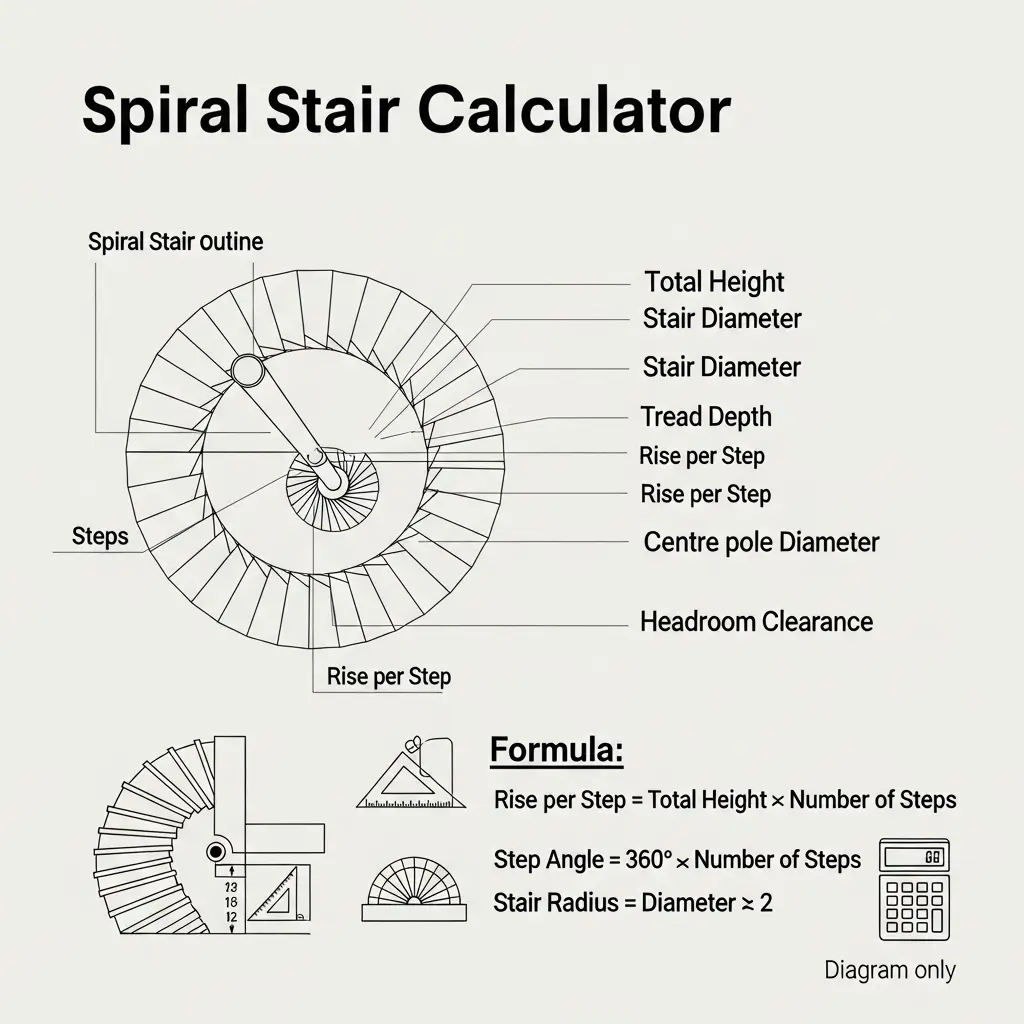

In a spiral staircase, the depth of the tread is not uniform; it is incredibly narrow near the center pole and wide at the outer edge. For safety, building codes regulate the "walking line."
The walking line is measured 12 inches out from the narrowest edge of the tread. At this exact point, the tread depth must be a minimum of 7.5 inches to provide adequate space for a foot to land securely. If the tread angle is too aggressive, or the diameter is too small, you will fail this safety check.
Under the International Residential Code (IRC), the minimum standard diameter for a spiral staircase serving as a primary means of egress is 60 inches (5 feet). This ensures adequate walking space.
Standard building codes require a minimum headroom of 6 feet 6 inches (78 inches). This is measured vertically from the edge of the tread straight up to the ceiling or landing above.
Yes, provided they meet specific requirements regarding diameter, tread depth at the walking line, and maximum riser height. Always consult your local municipality's specific amendments to the IRC.
The total rotation depends completely on your floor-to-floor height and the chosen tread angle. Most installations range between 270° and 360° to ensure the entry and exit points are logical for the floor plans.
Unlike traditional straight stairs (which usually cap around 7.75"), the IRC allows spiral staircase risers to be as tall as 9.5 inches to accommodate the unique geometry.
The walking line is the theoretical line where a person walks, measured 12 inches away from the narrow edge of the tread (where it connects to the center pole). The tread must be at least 7.5" deep at this exact line.
Drop a plumb bob or tape measure down the opening. Measure from the top of the finished floor of the upper level down to the top of the finished floor of the lower level. Do not measure ceiling height.
It is exceptionally difficult, if not impossible, to move large furniture (like mattresses or sofas) up a standard spiral staircase. Plan to hoist large items through upper windows or exterior doors if installing spirals.
Michael R.
Contractor
"Perfect for planning my loft conversion! The visualization helped me decide exactly where the top landing needed to end up."
Sarah B.
Interior Designer
"Great tool, works flawlessly. I just wish there was a toggle option for metric measurements since I order some parts from Europe."
Dave P.
DIY Builder
"Good graphics and quick math. But my local code is stricter than the IRC default, so I had to verify the headroom clearance myself."
Alicia G.
Homeowner
"Saved me from ordering the wrong custom kit. I didn't realize my entry would be backwards if I didn't get the angles right!"
John W.
Carpenter
"Very helpful visualization of the rotation angle. Saves me from drawing it out on graph paper every time."
Tom C.
Estimator
"A bit confusing to understand the walking line implications at first, but the math is accurate."
We'd love to hear from you! If you have suggestions, questions, or just want to say hello, please get in touch.