Phone:
(701)814-6992
Physical address:
6296 Donnelly Plaza
Ratkeville, Bahamas.

Phone:
(701)814-6992
Physical address:
6296 Donnelly Plaza
Ratkeville, Bahamas.
Estimate the total weight of snow on roof structures to ensure safety and stability.
Check local building codes (typically 20-60 psf).
Slippery surfaces may shed snow more easily.
Total Snow Load
0 lbs
Estimated Static Weight
Roof Load (psf)
0 psf
Area (Horizontal)
0 sq ft
Slope Factor
1.0
Est. Depth
0 ft
Your feedback helps us build better tools.
A Snow Load Calculator is a tool used to estimate the downward force exerted by accumulated snow on a roof structure. It uses ground snow load data, roof geometry, and surface characteristics to calculate the "sloped roof snow load." This is often a critical part of a broader roof dead load calculator assessment for structural safety in cold climates.
Assess the weight.
Enter the ground snow load (Pg) for your region. This is the baseline weight of snow on roof potential.
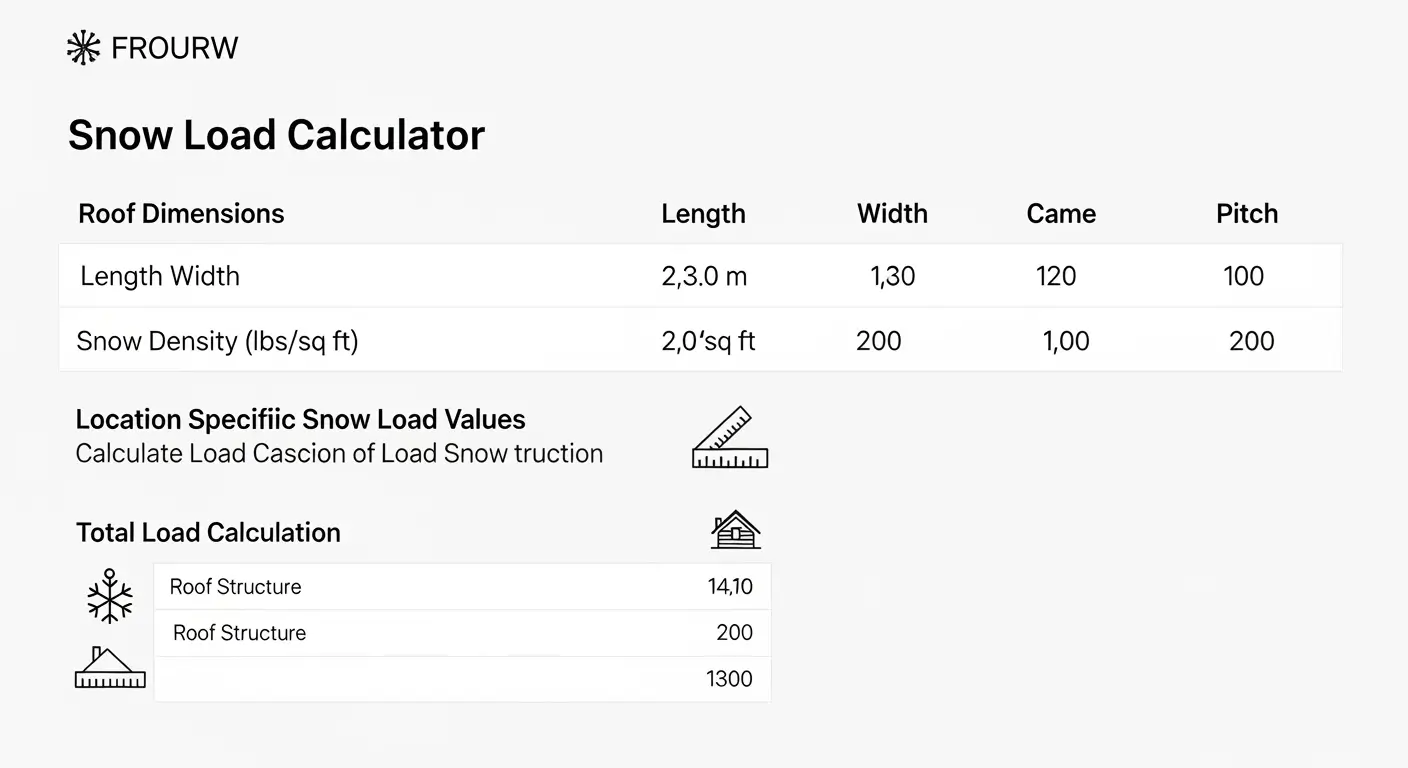
Enter the roof's width, length, and pitch. Steeper roofs shed snow, reducing the total load.
Get the total weight and load per square foot, adjusted for roof factors.
The formula converts ground load to roof load by accounting for wind, thermal conditions, and slope.
This helps engineers ensure the structure can support the heavy weight of snow on roof systems during winter.

It's important to distinguish between loads. A roof dead load calculator sums up the weight of the permanent structure (shingles, trusses, drywall). Snow load is a "live load"—it is temporary and variable.
However, when designing, these loads are combined (Dead Load + Snow Load) to determine the total required strength of the rafters and beams. Neglecting snow load in northern climates can lead to catastrophic collapse.
Ground snow load (Pg) is the weight of snow on the ground expected to be exceeded only once every 50 years. You can find this value in your local building codes or hazard maps.
Fresh snow can weigh as little as 3 pounds per cubic foot (pcf), while wet, heavy snow can weigh 21 pcf or more. Ice weighs about 57 pcf.
Steep roofs (typically > 30 degrees or 7/12 pitch) allow snow to slide off more easily, especially if the surface is slippery (like metal), reducing the retained load compared to flat roofs.
Yes. Select a pitch of "0/12". Flat roofs are more susceptible to snow accumulation and ponding, so calculating the load is even more critical.
James Dalton
Structural Engineer
"Excellent for quick checks. The slope reduction factor is handy."
Sarah Miller
Homeowner
"Nice app, but I wish I could switch to metric easily."
David Ross
Contractor
"Saved me calculating manually. I use it for every foundation pour."
Mike Ross
First-time User
"A bit complex for a simple DIY path, but it works."
Emily Chen
Architect
"Spot on for my foundation project. Highly recommended."
James Lee
Estimator
"Good for quick checks. The slope reduction factor is handy."
Karen White
Homeowner
"Finally, I understand how to calculate roof pitch properly. This tool is a lifesaver."
Robert King
Builder
"Nice app, but I wish I could switch to metric easily."
John Davis
Fabricator
"Helped me check my homework for structural analysis class. Accurate results."
We'd love to hear from you! If you have suggestions, questions, or just want to say hello, please get in touch.