Phone:
(701)814-6992
Physical address:
6296 Donnelly Plaza
Ratkeville, Bahamas.

Phone:
(701)814-6992
Physical address:
6296 Donnelly Plaza
Ratkeville, Bahamas.
Determine the safe and aesthetic post size for your structure.
Height from ground/deck to the beam.
Distance to next post.
Length of rafters supported.
Recommended Post Size
6 x 6
Standard for Stability
Est. Load
0 lbs
Trib. Area
0 sq ft
Slenderness
OK
Max Height
12'
Your feedback helps us build better tools.
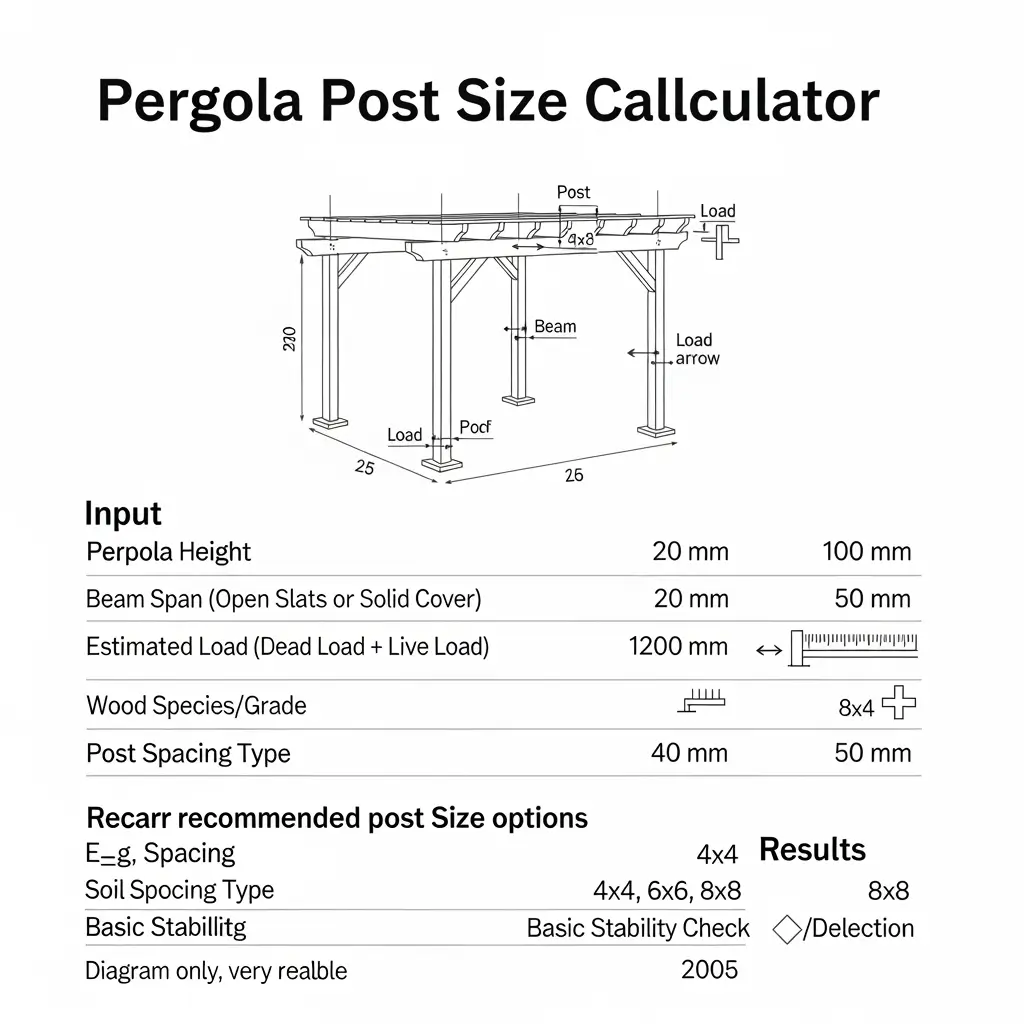
A Pergola Post Size Calculator determines the structural column size required to support your roof load without buckling. While rafters carry the weight across the span, the posts transfer that entire load to the ground. This tool evaluates height, weight, and material strength to recommend whether a standard 4x4 is sufficient or if a robust 6x6 or 8x8 is needed for safety and aesthetics.
Ensure solid support.
Estimate the weight the post must carry. This includes the weight of the wood, plus any snow or roof covering.
Taller posts are more prone to buckling. A 10-foot post needs to be thicker than a 6-foot post for the same load.
Most pergolas look best with 6x6 posts, but 4x4s can work for small, lightweight arbors.
Post sizing is governed by the "Tribulary Area"—the portion of the roof area supported by a single post—and the post's height.
Note: This calculator assumes a simplified tributary load for estimation. Corner posts typically carry 25% of the total roof load.
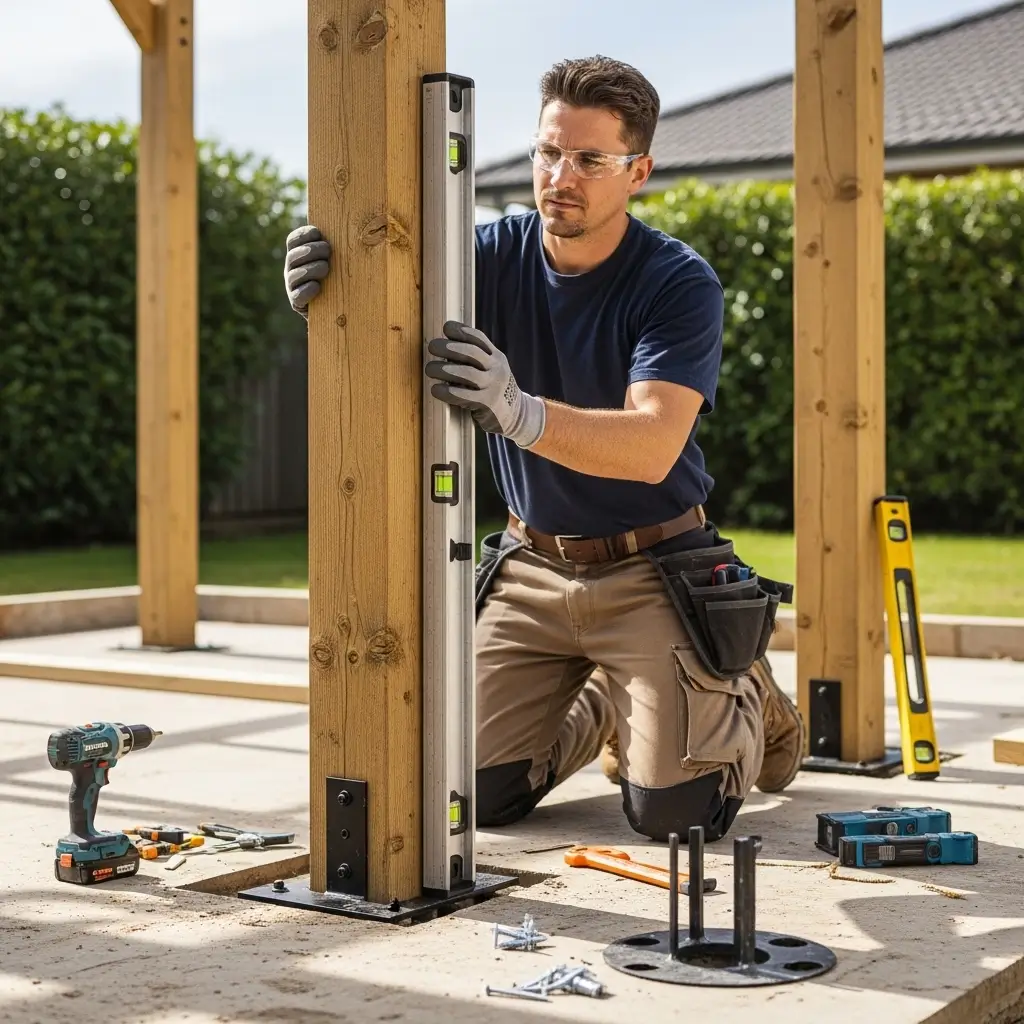
While a 4x4 post is structurally sufficient for many small pergolas, they often look thin and "spindly" compared to the overhead beams. They are also more prone to twisting and warping over time.
6x6 posts provide a robust visual anchor, offer more surface area for notching beams, and resist twisting much better. For spans over 10 feet or heights over 8 feet, 6x6 is the standard professional recommendation.
Technically yes, if it's open lattice with no snow load. However, 6x6 posts are strongly recommended for a 12x12 structure to prevent swaying and improve aesthetics.
A general rule is to bury 1/3 of the post height, or at least below the frost line in your area (often 30-48 inches). Check local codes.
No, Pressure Treated Yellow Pine is structurally stronger than Cedar. However, Cedar is naturally rot-resistant and less likely to twist. 6x6 Cedar posts are excellent for pergolas.
Yes. Posts must sit on or in concrete footings to support the vertical load and resist uplift from wind. Sinking posts in dirt will lead to rot and settling.
Generally, unbraced 4x4 posts should not exceed 8 to 10 feet in height. Beyond that, they become unstable and prone to buckling under load.
Yes, significantly. Even lightweight polycarbonate adds wind lift load, and solid roofs add snow load potential. Always use 6x6 posts if you plan to cover the pergola.
Using 6x6 for posts is great. Using 6x6 for beams is possible but heavy. Rafters are typically 2x6 or 2x8. It depends on the look you want.
You will need 6x6 post bases (anchors) for the concrete connection and appropriate cap connectors or carriage bolts for the beam-to-post connection.
James D.
Carpenter
"Simple and effective. Confirmed I needed 6x6s for my 12' span."
Sarah M.
DIYer
"Good tool. I wish it had an option for 8x8 posts explicitly."
David R.
Landscape Architect
"Using this along with the rafter calculator made my project planning seamless."
Mike L.
First-time User
"Okay, but I wanted to see 8x8 post options."
Emily R.
Architect
"This tool was invaluable for my custom home project. Confirmed 6x6 was the way to go."
James Lee
Estimator
"Good for quick checks. The max height calculation is a good safety feature."