Phone:
(701)814-6992
Physical address:
6296 Donnelly Plaza
Ratkeville, Bahamas.

Phone:
(701)814-6992
Physical address:
6296 Donnelly Plaza
Ratkeville, Bahamas.
Estimate the cost of professional lawn mowing services based on yard size and conditions.
Estimate the mowable area (1 Acre = 43,560 Sq. Ft).
Taller grass requires more passes or heavier equipment.
Obstacles require more weed-eating and maneuvering.
Average is between $10 - $20 depending on your city.
Estimated Mowing Cost
$62.50
Per Visit
45
Est. Minutes
Complexity Multiplier
1.0x
Equivalent Cost per Acre
$544.50
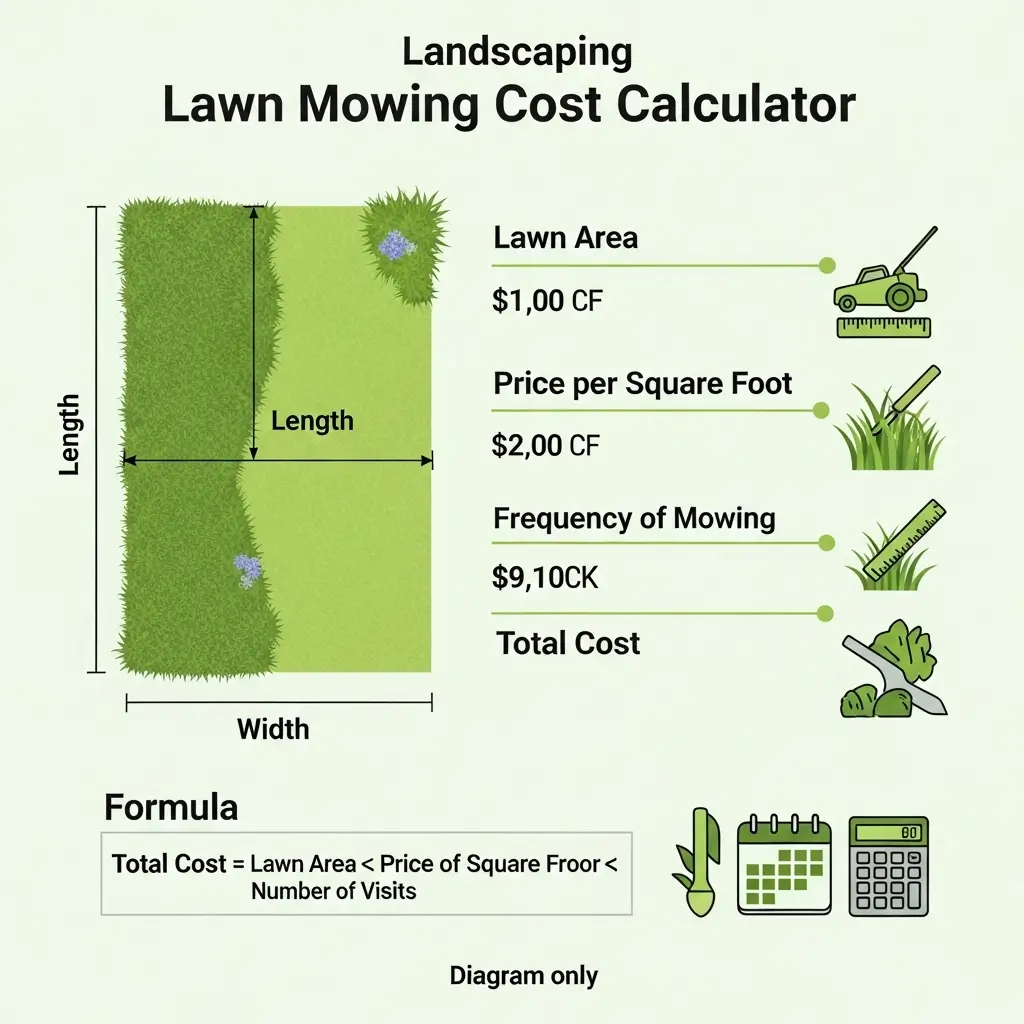
A Lawn Mowing Cost Calculator helps homeowners and lawn care professionals estimate fair pricing for yard maintenance. Rather than guessing a flat fee, this tool uses square footage and a base rate to provide an objective price.
Crucially, the calculator factors in real-world hurdles that landscapers face. If a yard is severely overgrown, or features steep hills and complicated landscaping beds, the time and wear-and-tear on equipment increases. The calculator applies standard industry multipliers to adjust the final price accordingly.
From raw yard to an accurate quote.
Determine the mowable area. Do not include the footprint of the house, driveway, or large patios. Only measure the grass.
Assess the height of the grass and the terrain. Overgrown grass forces mowers to slow down and often requires double-cutting to clear clumps.
Multiply the adjusted area by the local market rate. High cost-of-living areas have higher base rates to cover business overhead and fuel.
Most lawn care professionals charge based on blocks of 1,000 square feet, modified by a complexity factor that accounts for extra time spent trimming or dealing with difficult grades.
Many companies also enforce a "minimum stop fee" (usually around $35 - $45) regardless of how small the yard is, just to cover the cost of driving the truck to your house.
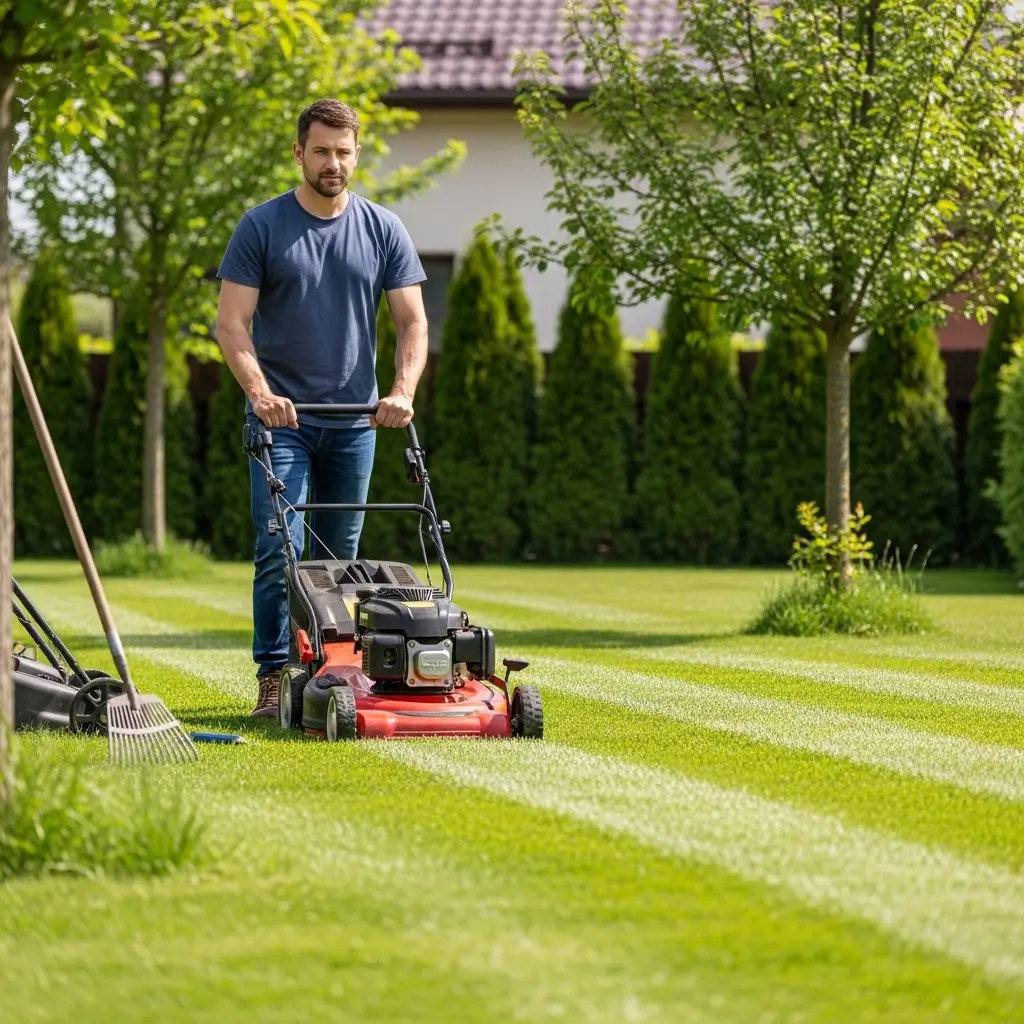
When you get a quote for a standard lawn mowing service, it usually includes three specific tasks to ensure a clean, professional finish.
Instead of charging per single square foot, professionals usually quote based on blocks of 1,000 square feet. The average national cost is roughly $10 to $20 per 1,000 sq ft, which translates to $0.01 to $0.02 per square foot.
Yes. If grass is over 6 to 8 inches tall, it often requires the landscaper to mow the lawn twice (once on a high setting, and again lower) to prevent damaging their equipment and leaving giant clumps of dead grass. Expect a 25% to 50% surcharge.
There are exactly 43,560 square feet in one acre. If your lot is 0.25 acres, your total lot size is 10,890 sq ft (though the actual mowable grass area will be less once you subtract the house and driveway).
Tipping for routine weekly lawn care is generally not expected or required. However, offering a tip or a holiday bonus at the end of the season for exceptional, reliable service is always appreciated by the crew.
Absolutely. Steep hills require specialized walk-behind equipment or extreme caution with riding mowers. Yards with many trees, trampolines, or garden beds require highly time-consuming weed-eating, driving the price up.
During the peak growing seasons (Spring and early Summer), weekly mowing is highly recommended to maintain grass health. In the heat of late Summer or during dry spells, transitioning to bi-weekly mowing is usually sufficient.
Trimming (weed eating) cuts grass horizontally where a mower can't reach, like against a fence. Edging uses a vertical blade to cut a crisp, 90-degree trench between the grass and a hard surface like a driveway.
Usually, no. However, very dense, thick grasses like Zoysia or Bermuda might require sharper blades and slower mowing speeds compared to thin Fescue, though most contractors do not upcharge specifically by grass species.
Sarah M.
Homeowner
"This was super helpful! I wanted to hire a neighborhood kid and wanted to make sure I offered a fair price for our half-acre lot."
Derek P.
Property Investor
"Good calculator. I wish there was an option to directly input Acres instead of converting to Square Feet first, but the math is solid."
Jessica T.
First-time Renter
"Okay estimate, but the prices in my expensive city are way higher than the default base rate, so you really have to know your local market first."
Tom R.
Homeowner
"This completely saved me from getting ripped off by a local company trying to overcharge for our simple flat yard."
Angela W.
Property Manager
"Nice visualization of the mowing pattern. Helped me budget out landscaping for multiple of our rental properties."
Brian G.
Contractor
"Simple, straight to the point, exactly what I needed to generate quick quotes for my clients in the field."
We'd love to hear from you! If you have suggestions, questions, or just want to say hello, please get in touch.