Phone:
(701)814-6992
Physical address:
6296 Donnelly Plaza
Ratkeville, Bahamas.

Phone:
(701)814-6992
Physical address:
6296 Donnelly Plaza
Ratkeville, Bahamas.
Calculate the total boxes, underlayment, and cost needed for your laminate or vinyl plank project.
Set to 0 if pre-attached.
Total Boxes Needed
0
Est. Cost: $0.00
Base Area
0 ft²
Area w/ Waste
0 ft²
Flooring Cost
$0
Underlay Cost
$0
Your feedback helps us build better tools.
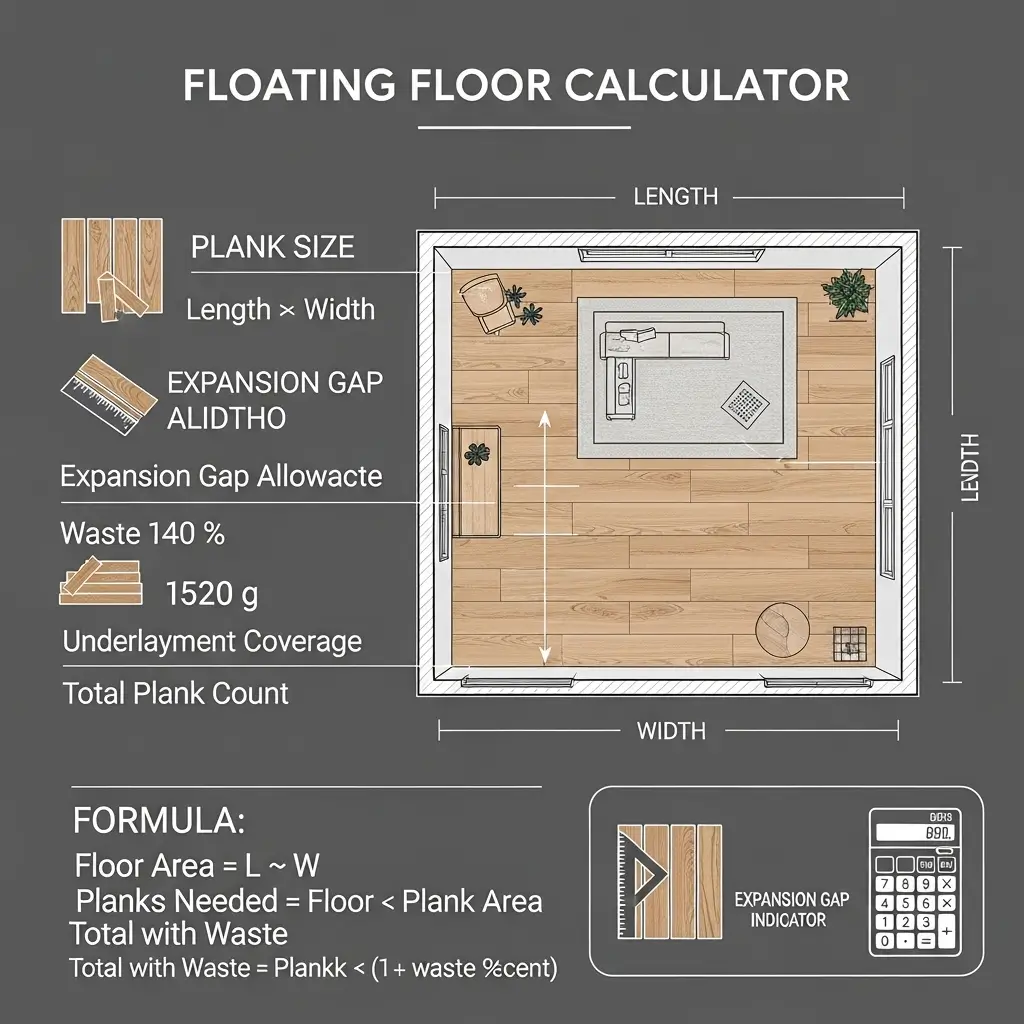
A Floating Floor Calculator is an essential planning tool for anyone installing laminate, luxury vinyl plank (LVP), or engineered hardwood. Floating floors lock together and "float" above the subfloor without nails or glue. Because planks must be staggered and cut at the ends of rows, you always need to order more square footage than the exact size of your room. This tool ensures you order the correct number of boxes and underlayment to finish the job without running short.
From subfloor to new floor.
Measure the longest length and widest width of the room. Don't subtract for closets or alcoves; treat it as one large rectangle to ensure enough material.
Look at the flooring product details. Every brand packages their planks differently, usually between 15 and 25 sq. ft. per box.
Always add at least 10% to your total square footage. This accounts for mistakes, angled cuts, and staggering the planks properly.
Calculating flooring is about guaranteeing you purchase enough full boxes to cover the total required square footage, including the safety margin.
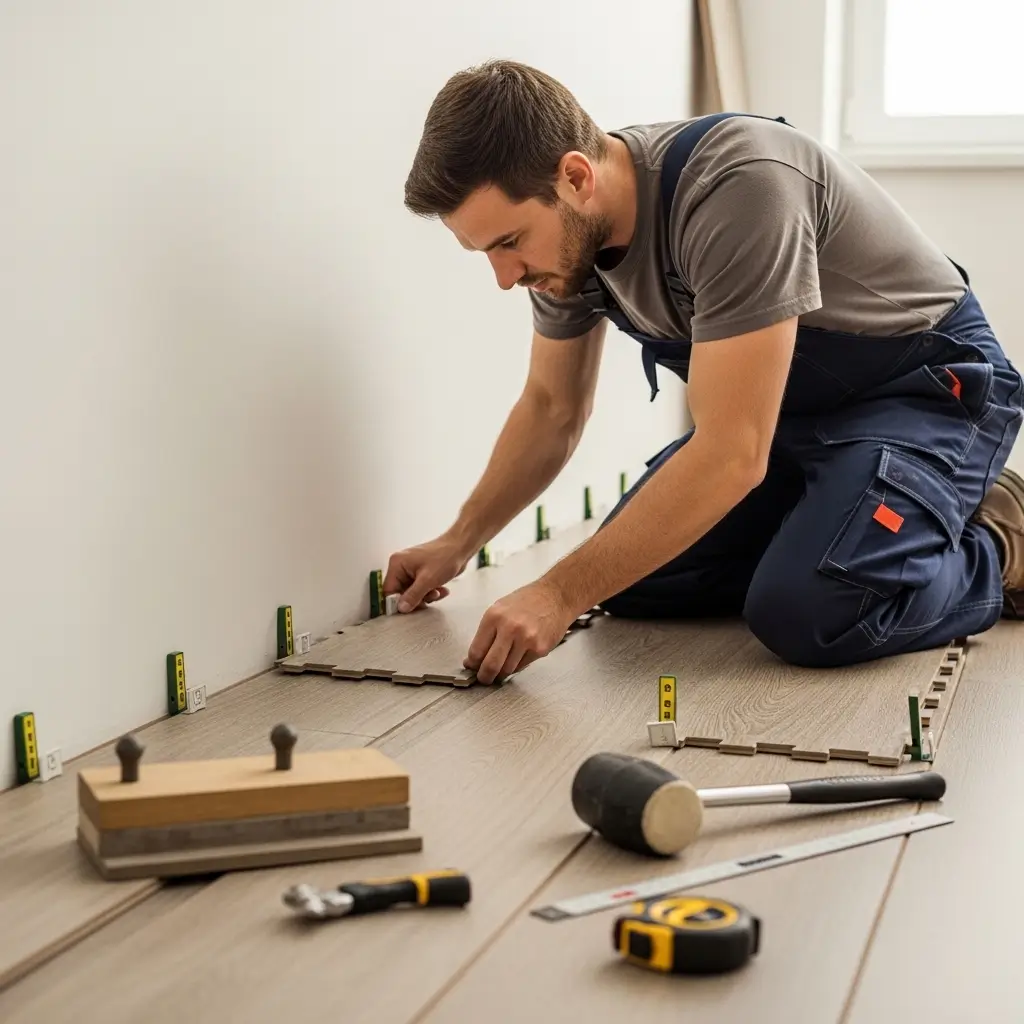
Unless your laminate or vinyl plank explicitly states it has an "attached pad," you must install an underlayment first. Underlayment provides a moisture barrier, smooths out minor subfloor imperfections, and dampens sound so the floor doesn't click or echo when you walk on it.
Underlayment is usually sold in rolls (e.g., 100 sq ft per roll). Use the "Area w/ Waste" number from the calculator above to know how much total underlayment you need.
A floating floor does not need to be nailed or glued to the subfloor. Instead, the individual planks feature a "click-lock" mechanism that holds them together, allowing the entire floor to rest (or float) on top of the subfloor or underlayment.
You will inevitably have to cut planks to fit the edges of your room, around doorways, and to stagger the joints properly. A 10% waste factor ensures you have enough material to cover these cuts and any accidental mistakes.
Yes, unless your flooring specifies it has a pre-attached underlayment pad. Underlayment is crucial for providing a moisture barrier (especially over concrete), dampening sound, and smoothing minor subfloor imperfections.
Floating floors expand and contract with temperature and humidity changes. You must leave a 1/4" to 1/2" gap between the flooring and all walls/obstacles. This gap is later covered by baseboards or quarter-round molding.
Yes, you can often float a new floor over existing hard surfaces like tile, concrete, or firmly attached vinyl. You cannot install floating floors over plush carpet or heavily damaged/uneven floors.
Break the room down into smaller rectangles. Calculate the length × width for each rectangle separately, add those total square footages together, and use that combined number as your base area.
It varies widely by brand and plank size. Typically, a box of laminate or LVP contains between 15 and 25 square feet. You must check the specific product packaging for this number before calculating.
Basic tools include a tape measure, utility knife, rubber mallet, tapping block, pull bar, and expansion spacers. You will also need a saw (miter saw, circular saw, or jigsaw) to cut the planks.
Mark T.
Homeowner
"Spot on! Calculated my LVP project exactly right. The 10% waste buffer saved me from running back to the store."
Sarah M.
DIYer
"Great tool for quick estimates. The visualizer helped me understand the stagger pattern."
David R.
Contractor
"As a contractor, I use this to double-check my material lists before ordering pallets of laminate."
Mike L.
First-time Installer
"It works well, but I had to figure out my box coverage manually first. Good math though."
Emily C.
Interior Designer
"Nice calculator. The addition of the underlayment cost is a feature most calculators miss."
James P.
Home Renovator
"Perfect for estimating. Took the guesswork out of ordering engineered hardwood for my living room."
Robert K.
DIY Enthusiast
"Very helpful for budgeting my basement floor, though regional pricing for the boxes varies."
Lisa W.
Homeowner
"Awesome tool! The waste factor dropdown is super helpful for rooms with lots of closets."
Dan H.
Handyman
"Does the job. I wish it had an option to switch to metric, but the square footage calculation is correct."
We'd love to hear from you! If you have suggestions, questions, or just want to say hello, please get in touch.