Phone:
(701)814-6992
Physical address:
6296 Donnelly Plaza
Ratkeville, Bahamas.

Phone:
(701)814-6992
Physical address:
6296 Donnelly Plaza
Ratkeville, Bahamas.
Determine rise, run, wood notches, cut angles, and board lengths required to build a safe staircase.
Finished lower floor to upper floor height.
OSHA/IRC standard is around 7" - 7.5".
Footing width surface depth.
Calculates bottom riser drop compensation.
Uncut backing timber left on 2x12.
Affects layout of the top notch cut.
Stringer Slope / Angle
34.6°
Safe and Code-Compliant
Number of Steps
14
Actual Riser Height
7.14"
Bottom Riser Cut
6.14"
Stringer Cuts (Qty)
3 Min
Your feedback helps us continuously evaluate and improve residential wood framing and building safety algorithms.
A Stair Stringer is the backbone of any set of stairs. It is the heavy structural framing timber (typically cut from structural 2x12 SPF or Douglas Fir boards) running diagonally from landing to landing that provides primary load-bearing support for the treads and risers.
In wood-frame residential carpentry, notch-cut stringers must be constructed with precision. A single millimeter of deviation in consecutive step heights creates a persistent tripping hazard. This calculator determines exact vertical and horizontal lines to cut so that your stairs are perfectly uniform, safe, and code-compliant.
Understanding safety rules and standard practices:
Determining identical step notches for safe travel.
Determine the total finished height difference from lower finished floor to upper deck or floor surface.
Select your desired unit measurements. Choose your target step riser height and footing tread depth.
Adjust step dimensions using exact math. Cut the bottom step notch short by your wood tread thickness to maintain a uniform step pattern.
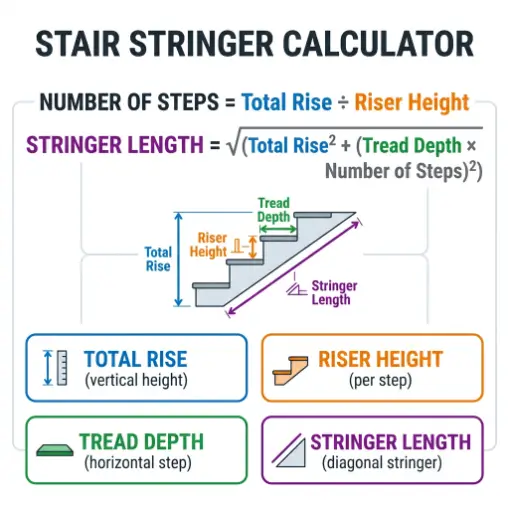
Determining the spacing cuts of staircases relies on trigonometry and arithmetic formulas to guarantee consistency:
$\text{Step Count} = \text{Round}(\text{Total Rise} / \text{Target Riser Height})$
$\text{Actual Riser} = \text{Total Rise} / \text{Step Count}$
$\text{Bottom Cut Riser} = \text{Actual Riser} - \text{Tread Thickness}$
$c = \sqrt{\text{Total Rise}^2 + \text{Total Run}^2}$
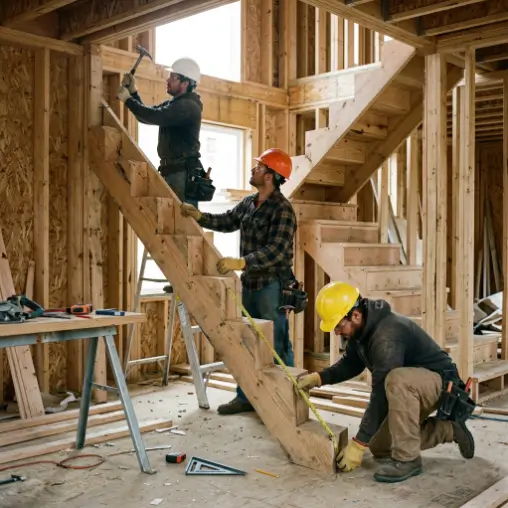
Stringers are crucial safety structures. Ensuring they are anchored correctly prevents structural failure and squeaking stairs.
The "Riser Sizing" Danger: Many DIYers make the mistake of leaving the bottom stringer notch raw. Once the floorboards or decking are installed, if you have not accounted for the thickness of the step wood, your bottom step is too tall by that amount, making it a severe code violation.
Top Header Hangers: Never rely purely on structural screws to hold the top of your stringers to a deck band. Always use structural steel framing hangers designed specifically for stairs to transfer load safely.
Uncut Throat Depth: When laying out your stair rise and run cuts on a 2x12 board, always ensure the uncut backing lumber is at least 5 inches thick. Sawing too far past your corner notches compromises structural load capacities.
You must cut the thickness of the tread material off the bottom end of the stringer. Because the tread material sits on top of each cutout, it adds height to every step. If you do not adjust the bottom, the bottom step will be too tall by the thickness of the tread, and the top step will be too short, creating a tripping hazard and code violation.
The most comfortable and safe angle for residential indoor or outdoor stairs is between 30 and 38 degrees. Steeper than 38 degrees makes descending the stairs feel dangerous; shallower than 30 degrees requires excessive run length and can feel awkward to climb.
The "7-11" rule represents ideal proportions: a maximum riser height of 7.75 inches and a minimum tread depth of 10 or 11 inches. In building safety codes (IRC), keeping step geometry close to these bounds helps prevent trips, matching the human natural gait.
Standard residential staircases require a minimum of two stringers. However, if the width of your staircase exceeds 30 to 36 inches, or if you are using wood composite decking (which sags more easily), you should install a third center stringer to ensure proper structural rigidity and support.
The throat depth is the uncut, continuous structural lumber left behind after the stair riser and tread notches are sawn out. Building regulations require this throat dimension to be at least 5 inches. Reducing this weakens the stringer, meaning it could snap under heavy human traffic.
Yes, standard dimensional lumber like SPF or Hem-Fir can cup, twist, or warp if exposed to heavy moisture prior to drying completely. For premium indoor or high-traffic commercial builds, engineered LVL stair stringers or pressure-treated yellow pine offer superior warp resistance.
Gregory Thorton
Framing Contractor
"This stair stringer layout calculator aligns exceptionally well with prescriptive IRC residential codes. It saves me from looking up the truss charts and jack-stud requirements during site estimations."
Sarah Jenkins
Residential Structural Architect
"Excellent layout. The bottom step drop compensation logic is flawless. It prevents rookies from creating dangerous uneven stairs on wood decks. Very helpful."
Arthur Pendelton
Home Improvement DIYer
"Good basic calculation and the canvas layout is extremely clear. However, if your building requires heavy steel stringers, you will still need custom engineering documents."
Genevieve Rousseau
Commercial Framing Foreman
"Our crews do a lot of structural remodeling. This estimator's riser-to-tread student output ratios align perfectly with local inspector expectations. Saved us from a framing citation last week!"
Douglas MacIntyre
Remodeling Carpenter
"Very handy web tool. The drop calculation for simple wood stair treads works precisely. It makes explaining structural requirements to clients very clear and visuals are sleek."
Jessica Albright
Shed & Deck Builder
"Nice structural guide. I build standard outbuildings, so SPF is our main wood type. This calculator accurately recommended we use a minimum of double-cut stringers for our wide entry deck."
We'd love to hear from you! If you have suggestions, architectural sizing questions, or just want to say hello, please get in touch.