Phone:
(701)814-6992
Physical address:
6296 Donnelly Plaza
Ratkeville, Bahamas.
Phone:
(701)814-6992
Physical address:
6296 Donnelly Plaza
Ratkeville, Bahamas.
Quickly estimate the total gallons or liters of water required to fill your swimming pool.
Total Water Capacity
0
Gallons (US)
Liters
0
Cubic Feet
0
Avg Depth
0'
We appreciate your feedback for our pool engineering tools.
A Pool Volume Calculator is a vital resource for pool owners and maintenance professionals. Knowing the exact water capacity of your pool is the first step in correctly balancing chemicals, purchasing a heater, or estimating the time required for a full drain and refill.
Unlike simple cubic calculations, pools often have varying floor depths. This tool allows you to input separate shallow and deep-end depths to find an Average Depth, resulting in a much more accurate volume measurement than standard "length x width" formulas.
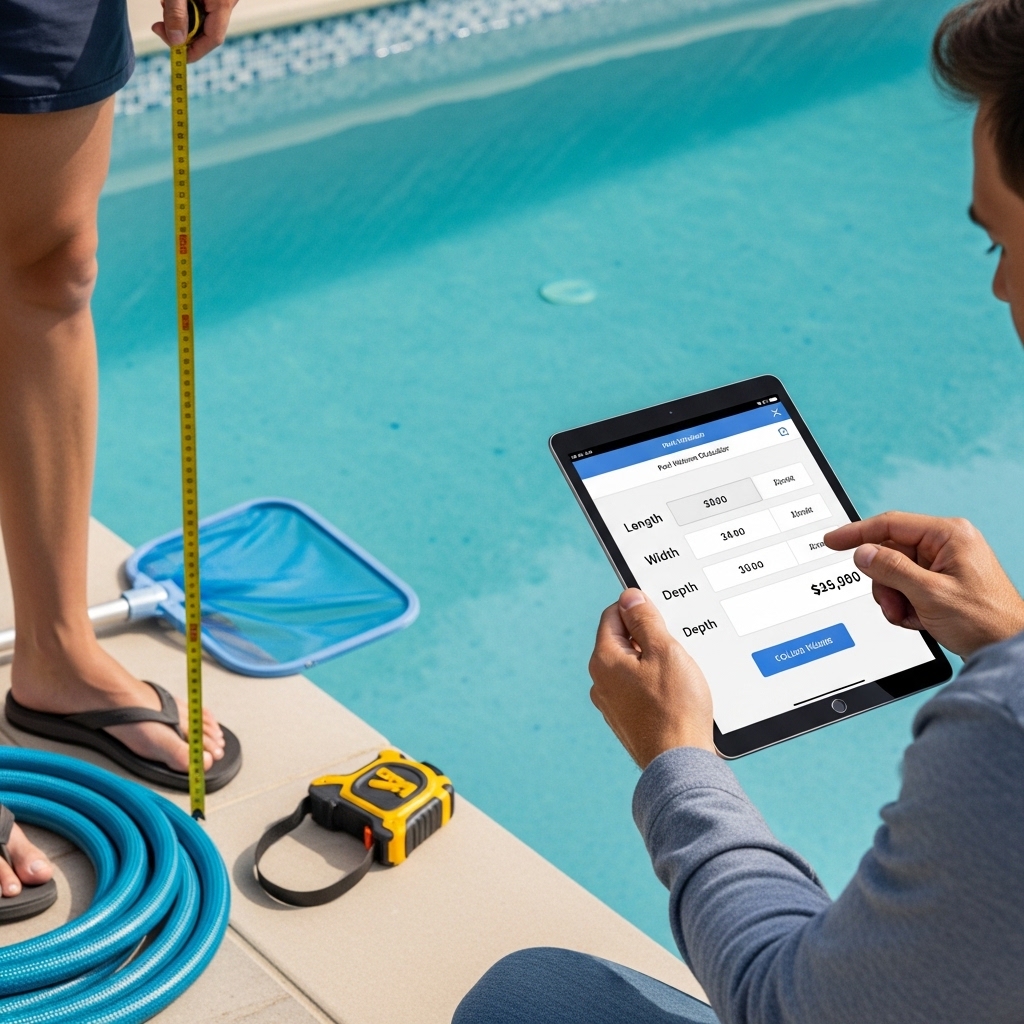
Measure and calculate in four easy steps:
Cubic feet to Liquid Gallons.
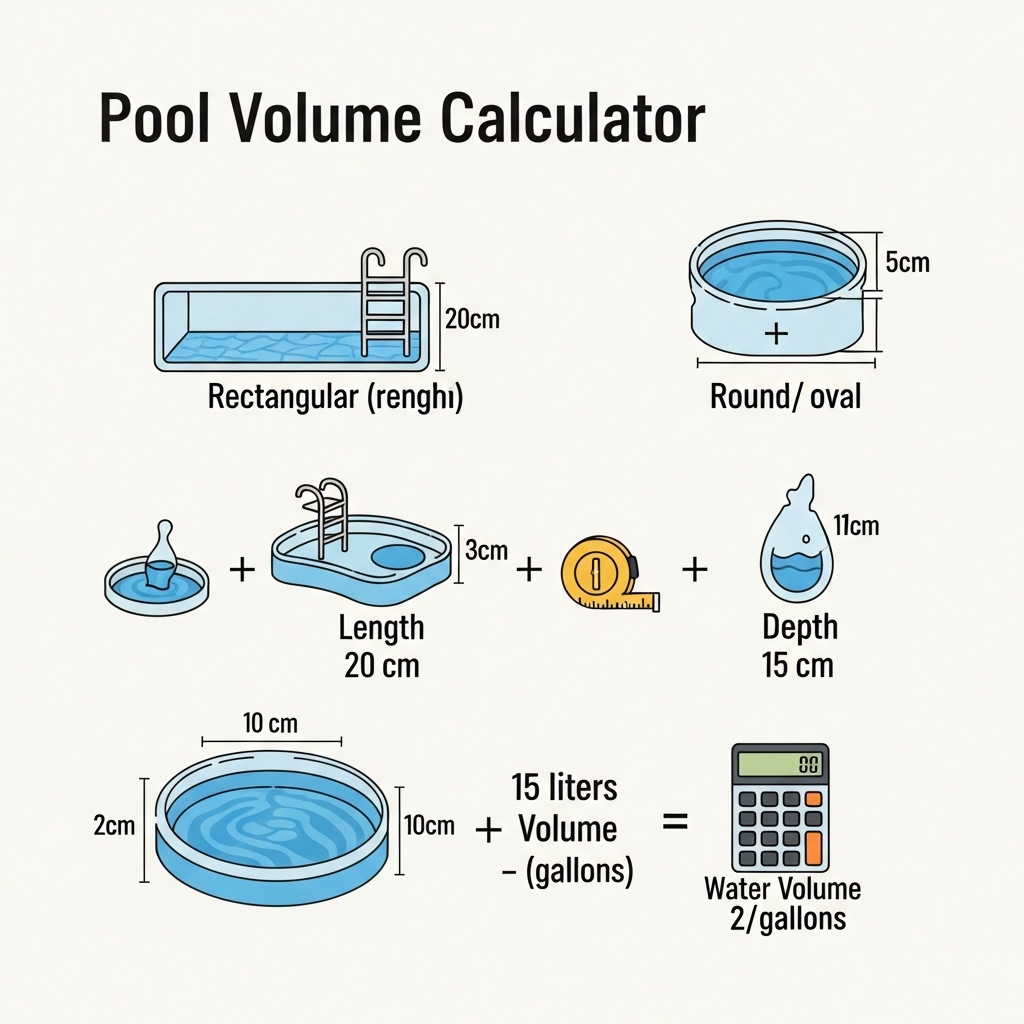
Based on shape (L x W for rectangles, $\pi \times r^2$ for circles).
Average the shallowest and deepest points: $(\text{Shallow} + \text{Deep}) / 2$.
Multiply cubic feet by 7.48 to find the total US Liquid Gallons.
We use standardized pool math to ensure chemical levels remain safe and effective.
Calculating volume is about more than just filling the pool; it's about water chemistry. Shocking a pool or adding muriatic acid requires knowing the exact volume to avoid damaging the pool liner or irritating the eyes of swimmers.
A typical residential pool ranges from 10,000 to 20,000 gallons. If you find your result is outside this range, double-check your depth measurements. Remember that "water level" depth is usually 6 inches lower than the actual wall height.
Almost all pool chemical instructions are based on gallons (e.g., "Add 1 lb of shock per 10,000 gallons"). Without this number, you risk over-treating or under-treating your water.
The oval pool formula ($L \times W \times \text{Depth} \times 5.9$) is a high-accuracy estimation. Most oval pools are "stadium" shaped, and this multiplier accounts for the curved ends effectively.
Always measure to the actual water line (usually halfway up the skimmer opening) for chemical dosage. Measuring to the rim will overestimate your volume by several hundred gallons.
For kidney-shaped or "freeform" pools, it's best to break the pool into smaller rectangles or circles, calculate them individually, and add them together for a total estimate.
Average depth accounts for the slope of the pool floor. By adding the shallowest point (e.g. 3ft) and the deepest point (e.g. 8ft) and dividing by 2 (5.5ft), you get a median depth for volume math.
A standard garden hose delivers about 5-9 gallons per minute. Filling a 15,000-gallon pool can take anywhere from 28 to 50 hours of continuous running.
Derek Anderson
Professional Pool Technician
"This is my go-to for field estimates. The average depth feature is crucial because most homeowner pools aren't a flat 5 feet."
Samantha Reed
First-time Pool Owner
"Finally realized I was double-shocking my pool because I overestimated my gallon count. This tool saved me a fortune in chemical waste."
Marcus Sterling
Service Engineer
"Highly accurate. I use this when quoting heater installations for my clients. Professional UI works great on my phone."
We'd love to hear from you! If you have suggestions, questions, or just want to say hello, please get in touch.