Phone:
(701)814-6992
Physical address:
6296 Donnelly Plaza
Ratkeville, Bahamas.

Phone:
(701)814-6992
Physical address:
6296 Donnelly Plaza
Ratkeville, Bahamas.
Accurately calculate the storage capacity and current fill volume of various tank shapes.
Current Liquid Volume
0
Gallons (US)
Liters
0
Cubic Feet
0
Total Cap.
0 Gal
Fullness
0%
Your feedback helps us build better tools.
A Tank Volume Calculator is an essential tool for engineers, contractors, and homeowners to determine the storage capacity of various containers. Whether you are managing water storage, chemical tanks, or fuel reservoirs, knowing the exact volume is critical for safety and logistics.
This tool goes beyond simple math by providing fill level calculations. For horizontal cylinders, the volume does not change linearly with height, requiring complex circular segment formulas that this calculator handles automatically.
Follow these steps to find your tank's capacity:
Accuracy through geometry.
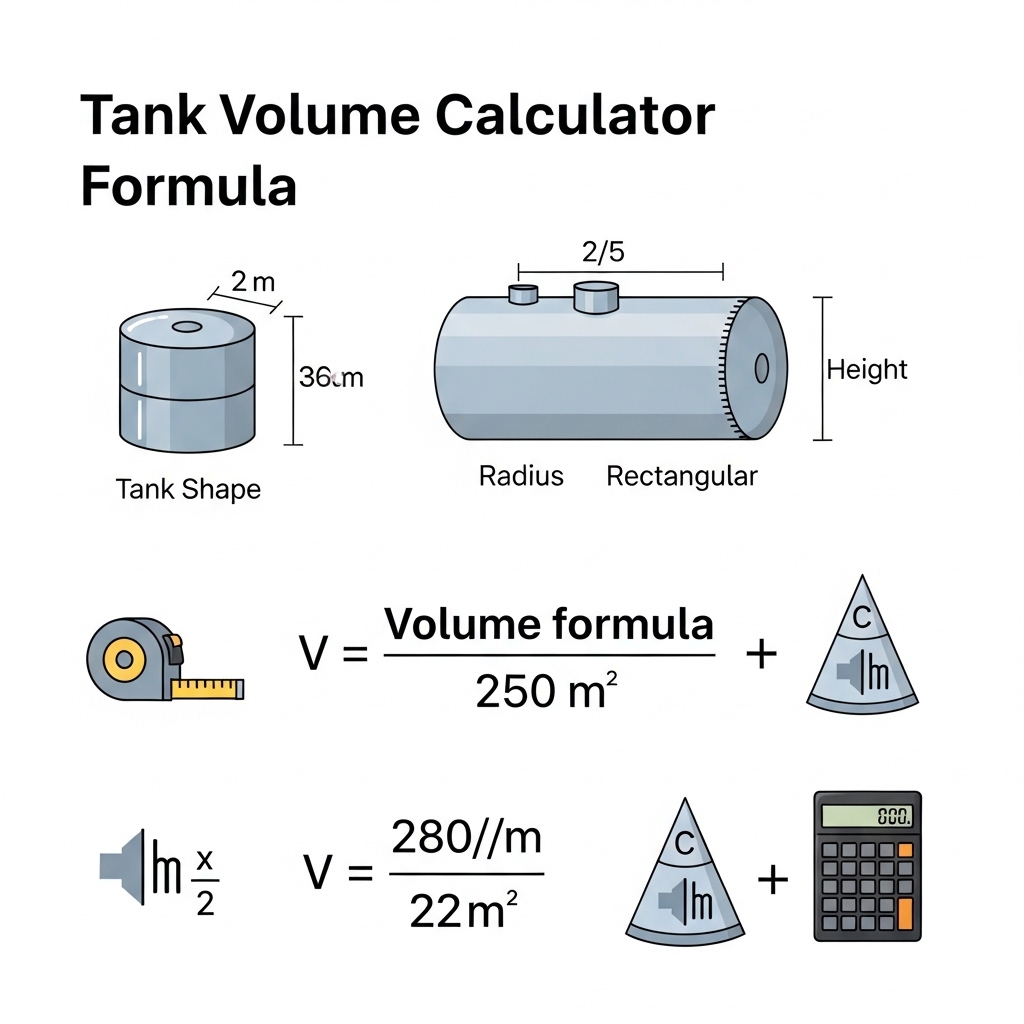
For rectangles, it's L × W. For cylinders, it's $\pi \times r^2$. This defines the footprint of your storage.
Total volume is simply Base Area × Height. This gives the maximum capacity of any upright container.
Calculating partial volume involves comparing the fill height to the total height, using circular segment area for horizontal tanks.
We use standard geometric formulas to ensure precision across all tank types and liquid levels.
Note: For horizontal tanks, the fill volume is calculated using the area of a circular segment multiplied by the tank length.
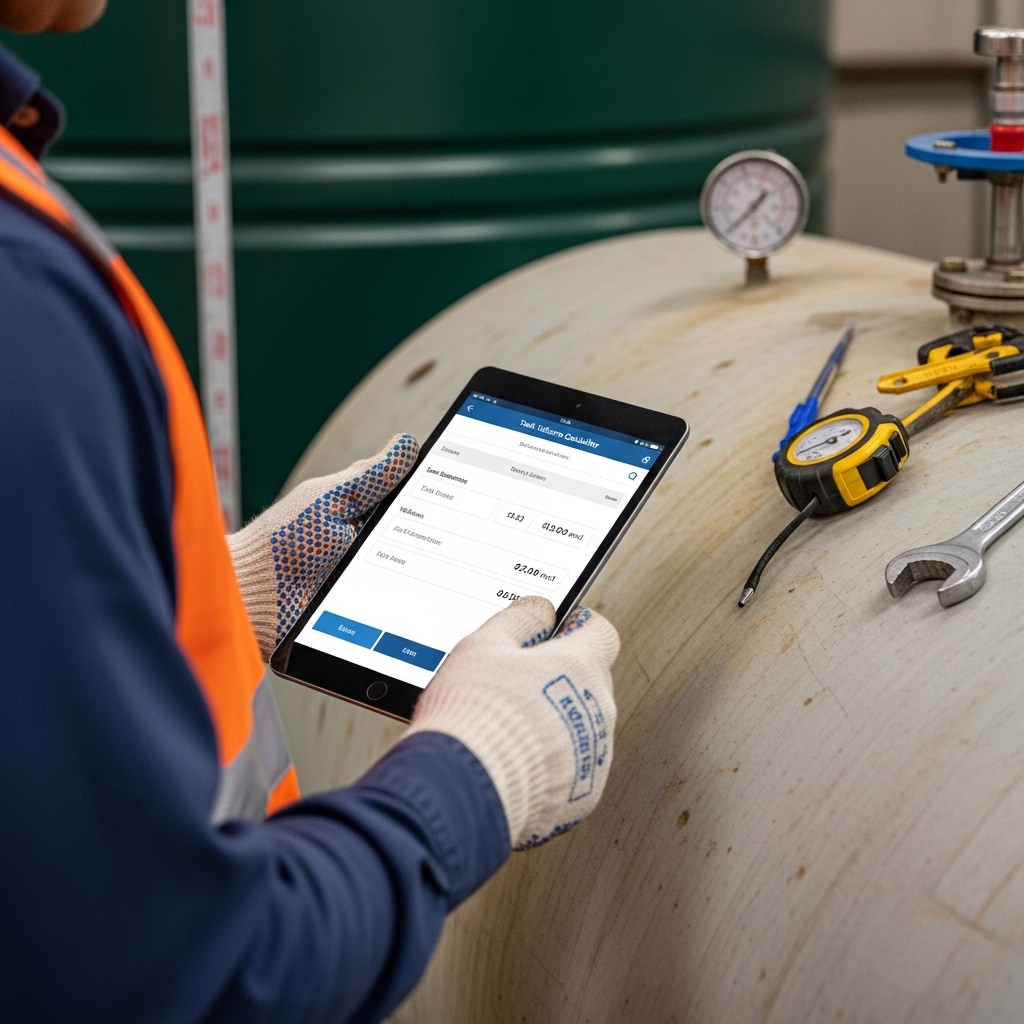
In industries like agriculture, manufacturing, and construction, tank measurements are more than just numbers. Overestimating capacity can lead to dangerous overflows, while underestimating can halt production or leave you short on critical resources like fuel or water.
Our calculator provides real-time conversions between Gallons, Liters, and Cubic Feet, allowing you to quickly communicate needs to suppliers or team members without manual conversion errors.
In a vertical tank, volume increases linearly with height. In a horizontal tank, the "width" of the liquid surface changes as the tank fills, requiring trigonometry to calculate the area of the circular segment occupied by the liquid.
This calculator uses US Gallons ($1 \text{ Gallon} \approx 3.785 \text{ Liters}$). If you are in the UK or Canada, you may need to convert the result to Imperial Gallons ($1 \text{ Imperial Gallon} \approx 4.546 \text{ Liters}$).
This calculator assumes flat ends. If your tank has "dished" or "elliptical" ends, your actual volume will be slightly higher than the result provided here.
Liquid volume changes with temperature. This calculator provides geometric volume. For precision with fuels, account for the temperature expansion coefficients.
Robert Jenkins
Logistics Manager
"Finally a tool that handles partial horizontal tank volumes correctly. I use this every day for site surveys."
Sarah Thompson
Property Owner
"Super easy to use. I needed to know how many gallons were left in my water tank and the visualizer made it very clear."
David Miller
Site Engineer
"Highly reliable formulas. We use this to verify site storage capacities before pouring concrete. It's accurate every time."
Michael Chen
Industrial Plumber
"The unit conversion between Liters and Gallons is a lifesaver. Saved me from ordering the wrong sized pump twice now."
Elena Rodriguez
Agricultural Planner
"Managing irrigation reservoirs is complex, but this calculator simplifies the volume estimation for my horizontal tanks. Very impressive."
Kevin O'Brien
HVAC Technician
"Quick, clean, and reliable. The mobile layout works great out in the field when I'm checking fuel storage units."
We'd love to hear from you! If you have suggestions, questions, or just want to say hello, please get in touch.