Phone:
(701)814-6992
Physical address:
6296 Donnelly Plaza
Ratkeville, Bahamas.

Phone:
(701)814-6992
Physical address:
6296 Donnelly Plaza
Ratkeville, Bahamas.
Quickly estimate how many pickets and posts you need to build your perfect fence.
The total linear perimeter of your project.
E.g., A nominal 1x6 is usually 5.5" actual.
Enter 0 for full privacy, or add a gap size.
Optional. Used to calculate total picket cost.
Required Pickets & Cost
328
Total Pickets
$934.80
Est. Picket Cost
Est. 8ft Panels
19 Panels
Est. Posts Needed
20 Posts
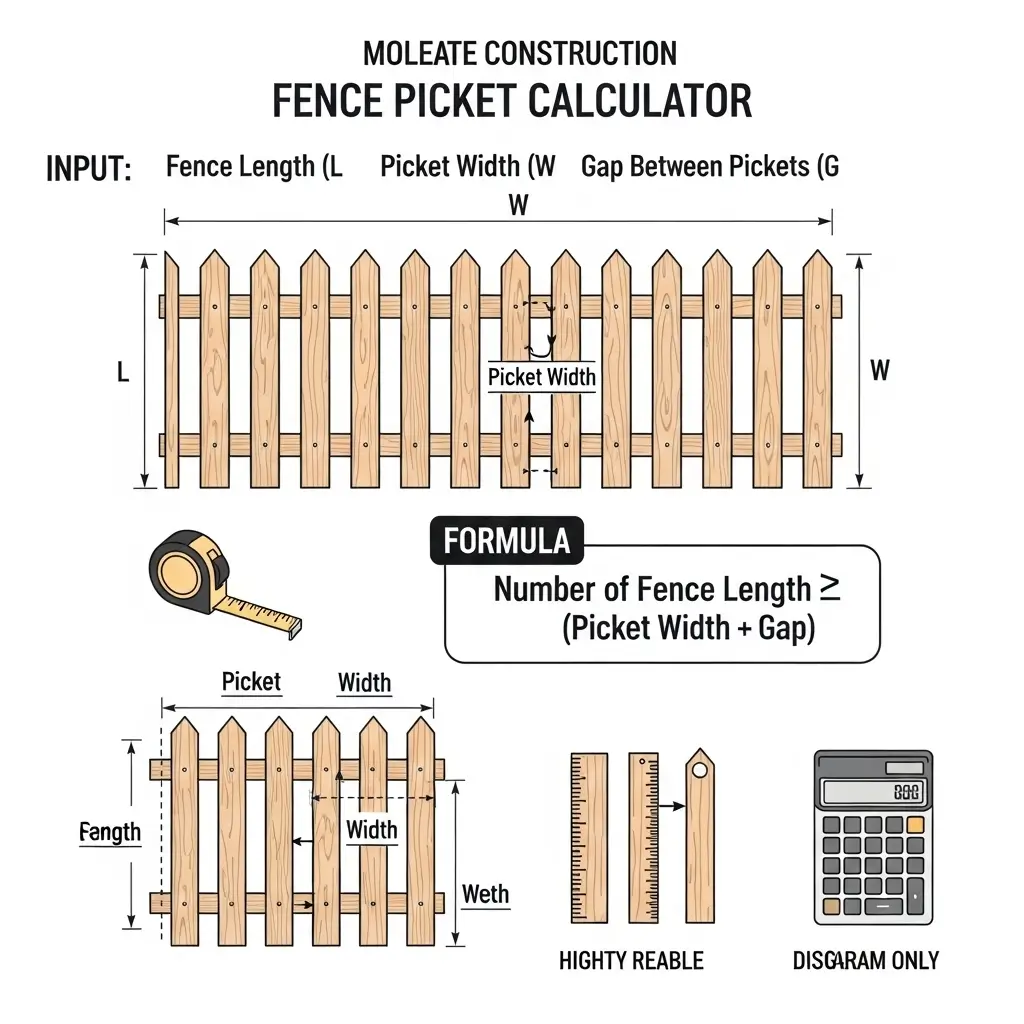
A Fence Picket Calculator takes the total linear footage of your yard and divides it by the width of your selected pickets (plus any gaps) to tell you exactly how many individual boards you need to buy.
Because buying too few pickets means extra trips to the lumber yard, and buying too many wastes money, accurate calculations are essential for both DIY homeowners and professional fencing contractors. It also provides a quick baseline for the number of standard 8-foot panels and 4x4 posts required.
From property lines to a finished fence.
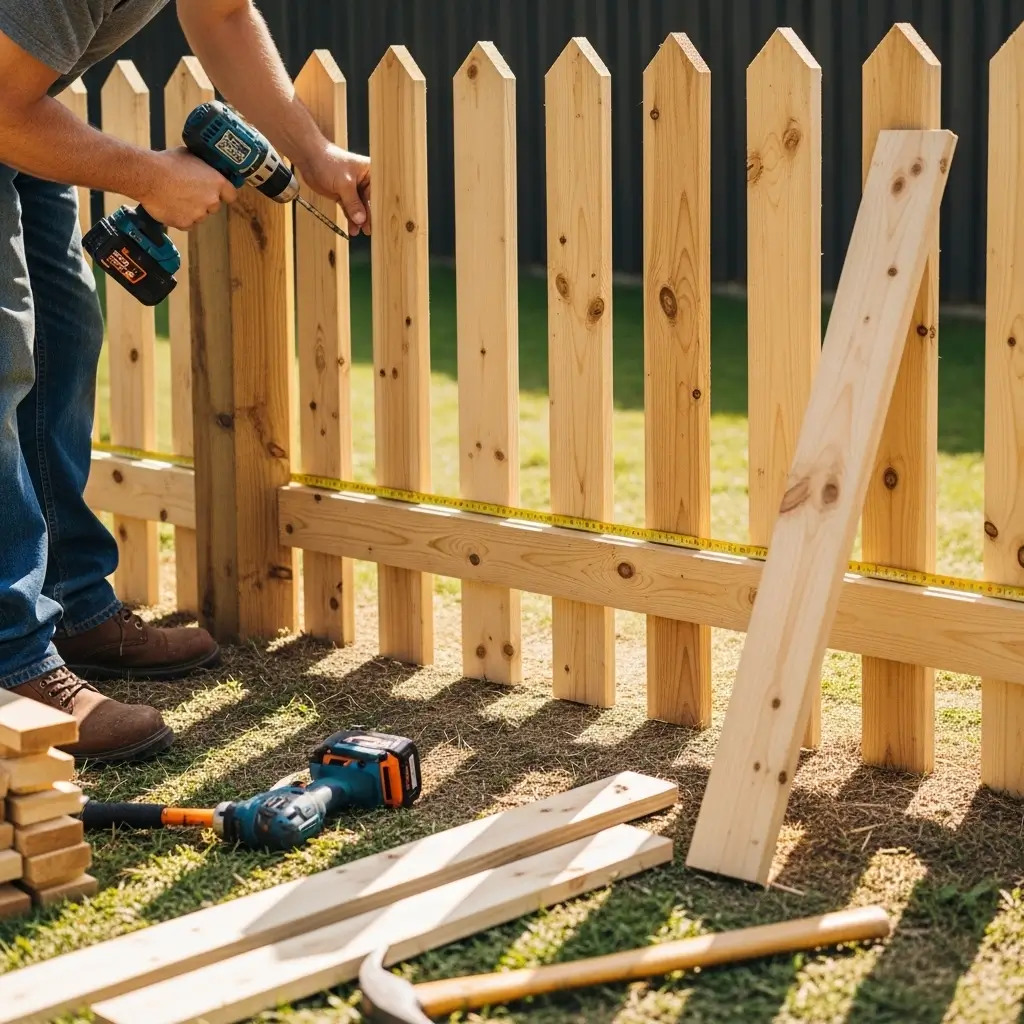
Use a long tape measure or measuring wheel to find the total linear feet of your intended fence line, excluding any pre-existing structures.
Lumber sizes are tricky. A "1x6" picket is rarely 6 inches wide. Most measure 5.5 inches actual width. Be sure to use the actual width!
For a full privacy fence, enter 0 for spacing. If you want a traditional spaced picket look, enter your desired gap (e.g., 1.5 inches).
The formula converts your total fence length into inches, and divides it by the total width footprint of one picket plus its adjacent gap.
Note: Always add 5% to 10% extra to your final picket count. Some boards from the lumber yard will be warped, split, or damaged.
The style of fence you choose drastically alters how many pickets you need:
Multiply your total fence length in feet by 12 to get inches. Then divide that number by the width of one picket plus any gap you want between them.
A nominal 1x6 picket is typically exactly 5.5 inches wide, and a nominal 1x4 picket is typically 3.5 inches wide. Always measure a sample picket before buying materials in bulk.
For privacy fences, 0 inches. For traditional spaced wood fences, gaps are usually between 1.5 and 2.5 inches. Many builders use the width of a 2x4 (1.5") as a quick spacer block while nailing.
Yes. You should over-order by about 5% to 10%. Some pickets will have large knots, be warped, or split when you nail them. You also may need to cut pickets at the end of a fence line.
The standard rule is one post every 8 feet, plus one extra for the end of the line. So divide your total length by 8, round up, and add 1. Don't forget to account for gate posts!
Nominal size (like 1x6) is the size of the rough board before it was planed smooth at the mill. The actual size is the final physical measurement you buy at the store (like 5.5 inches).
For a standard 6-foot tall privacy fence, you should use 3 horizontal backer rails per 8-foot section to prevent the pickets from warping over time. For a 4-foot fence, 2 rails is sufficient.
Yes, but you need to adjust your math. Enter your desired spacing (e.g. 3.5 inches) into the calculator to see how many pickets fit on ONE side. Then multiply the total picket result by 2, since you are doing both sides of the rail.
Derek H.
Homeowner
"Great for planning my privacy fence. Ordered exactly what I needed and only had about 4 damaged boards left over."
Angela W.
DIYer
"Good tool, but a visual toggle for shadowbox fences would be nice. I just had to double the final number instead."
Mark R.
Fence Installer
"Spot on! The estimate for the posts is also a very helpful secondary stat so I know how much concrete to buy."
Tim P.
Carpenter
"Accurate math, but you have to know that you MUST enter the actual width of the picket. If you enter 6 inches for a 1x6, you will be short."
Lisa B.
DIY Builder
"Nice layout. I used the cost feature to compare the overall price of using wider cedar pickets versus standard pine."
Chris M.
Estimator
"Very easy to use. The canvas visual is helpful to make sure the spacing ratio looks correct before I buy."
We'd love to hear from you! If you have suggestions, questions, or just want to say hello, please get in touch.