Phone:
(701)814-6992
Physical address:
6296 Donnelly Plaza
Ratkeville, Bahamas.

Phone:
(701)814-6992
Physical address:
6296 Donnelly Plaza
Ratkeville, Bahamas.
Determine the perfect pitch, drop, and rafter length for proper drainage.
Distance from house/high post to low post.
Required Drop (Rise)
0"
Height difference between posts
Rafter Length
0' 0"
Tail Length
0"
Total Length
0' 0"
Pitch (in/ft)
1"
Your feedback helps us build better tools.
A Pergola Roof Slope Calculator helps you design the correct pitch for your outdoor structure. While traditional pergolas have flat beams, adding a solid roof (like polycarbonate or metal) requires a minimum slope to shed rain and snow. This tool calculates exactly how much lower your front posts need to be compared to the back ledger to achieve efficient drainage.
Design for drainage.
Determine the horizontal distance from the house wall (or rear posts) to the front posts.
Choose a minimum slope. 5 degrees is standard for plastic roofing to self-clean.
The calculator gives you the vertical drop needed to achieve your target slope.
Calculating the slope involves using the tangent function to relate the vertical drop to the horizontal run.
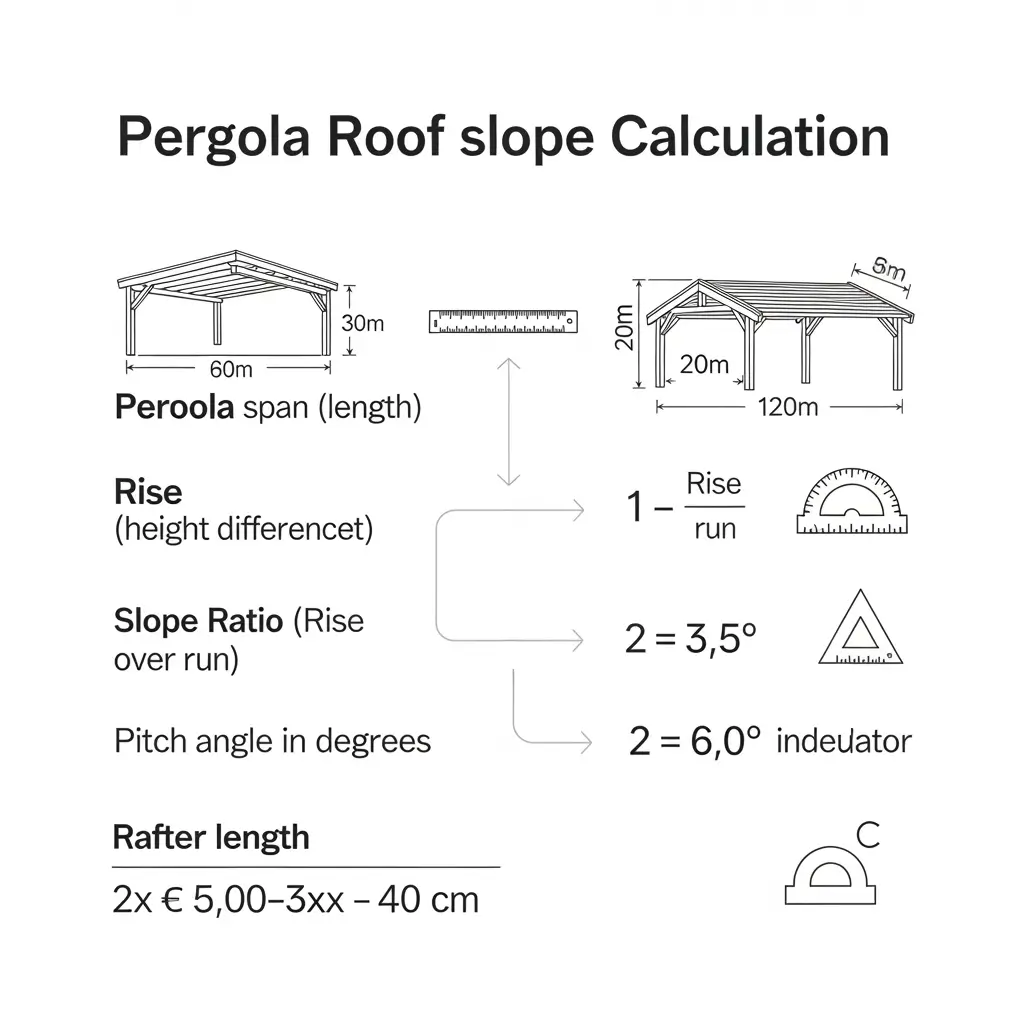

Without adequate slope, water will pool on top of your pergola roof. This adds immense weight, promotes algae growth, and can cause leaks or structural failure.
For polycarbonate sheets, manufacturers specify a minimum of 5 degrees fall to ensure rainwater washes away dirt and debris, keeping your roof clean and clear.
Most manufacturers recommend a minimum slope of 5 degrees (approx 1 inch rise per foot of run) to ensure proper water runoff and self-cleaning.
You can if it has an open lattice roof. However, if you plan to add a solid roof later, you must build in a slope now, or water will pool and damage the structure.
Measure the horizontal distance from the attachment point (e.g., house wall) to the outside edge of the supporting post beam. Do not measure the diagonal rafter length.
They are often used interchangeably. Slope is typically degrees or rise/run ratio (e.g., 1/4" per foot). Pitch is a ratio of total rise over total span (e.g., 4/12). This calculator handles both.
The "Rafter Length" result is the span between supports. The "Total Length" includes the overhang you specify. Always cut rafters slightly longer to allow for trimming.
Typically rafters are spaced 16" or 24" on center (OC). Divide your total width by the spacing (in feet) and add 1 to get the count. E.g., 20' width / 2' spacing + 1 = 11 rafters.
James D.
Carpenter
"Used this to calculate the drop for my lean-to. Worked perfectly."
Sarah M.
DIYer
"Simple and effective. Good visual aid for the pitch."
David R.
Contractor
"Helped me confirm the post heights for a client build. Reliable."
Mike L.
First-time User
"Fine, but I wish I could input the exact height I want instead of just the pitch."
Emily R.
Architect
"Must-have for planning drainage. The degree conversion is perfect."
James Lee
Estimator
"Solid calculator. The diagram updates instantly."
Robert K.
DIYer
"Ok, but I needed a metric version."
John D.
Fabricator
"Saves me a ton of time on small outbuilding jobs."
David G.
Estimator
"This tool was invaluable for my custom home project. The gauge price difference was clear to see."
We'd love to hear from you! If you have suggestions, questions, or just want to say hello, please get in touch.