Phone:
(701)814-6992
Physical address:
6296 Donnelly Plaza
Ratkeville, Bahamas.

Phone:
(701)814-6992
Physical address:
6296 Donnelly Plaza
Ratkeville, Bahamas.
Find the right lumber dimensions for your span and spacing.
Distance between the supporting beams.
Heavier loads require deeper rafters.
Recommended Size
2 x 8
Max Span for this size: 13' 4"
Spacing
16" OC
Wood Type
Pine
Load
Light
Beam Rec.
2x(2x8)
Your feedback helps us build better tools.
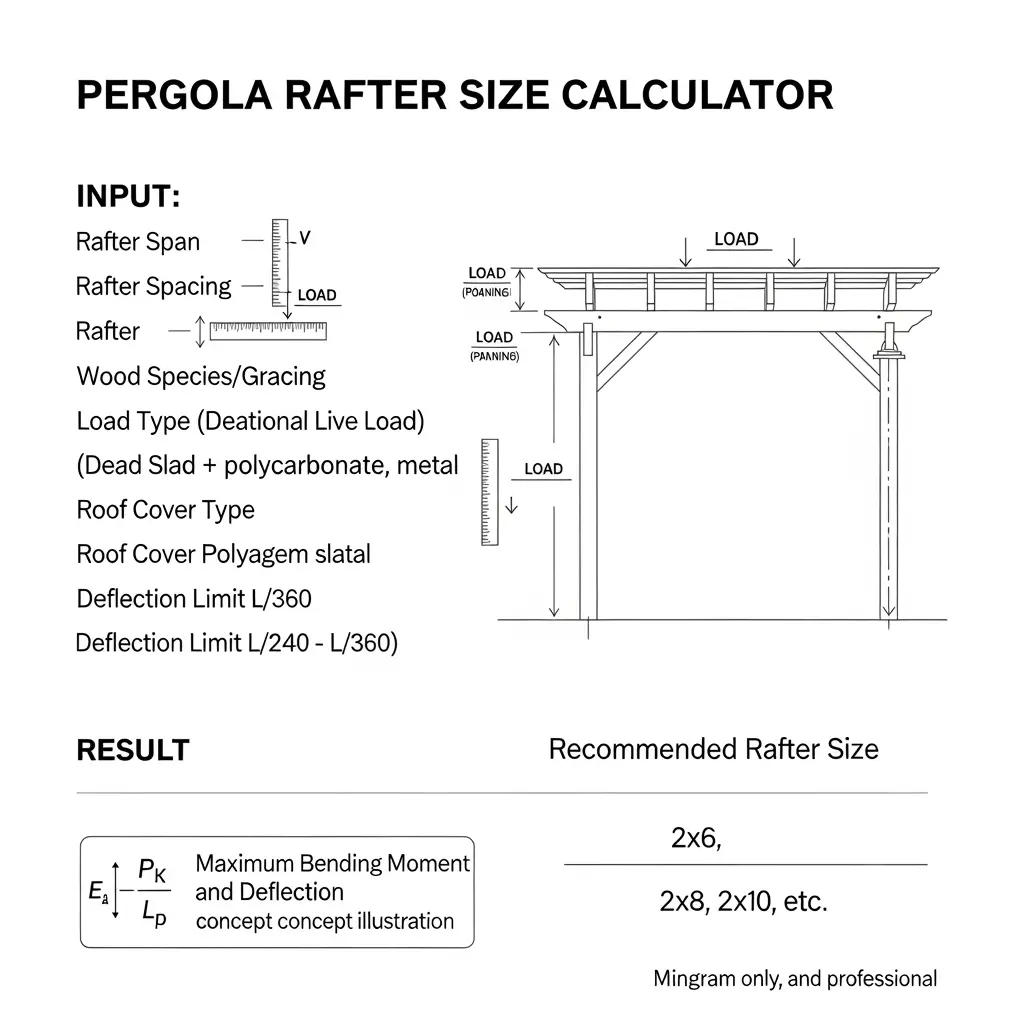
A Pergola Rafter Size Calculator ensures your outdoor structure is safe and stable by determining the minimum lumber size required for your specific span. Unlike decks, pergolas often use unbraced wood spans that can sag over time if undersized. This tool cross-references load requirements, wood species strength, and rafter spacing to recommend the correct 2x6, 2x8, or larger board.
Select the right lumber.
Measure the "clear span" distance between the inner faces of the supporting beams or posts.
Select your material. Southern Pine is stronger than Cedar, meaning it can span further with the same size board.
If you plan to add a heavy roof or live in a snowy area, you'll need deeper rafters (e.g., up-sizing from 2x6 to 2x8).
This calculator uses simplified span tables derived from the American Wood Council for visual grade #2 lumber. Results are based on allowable deflection (L/240).
Note: This is for estimation. Always consult local building codes for permits.
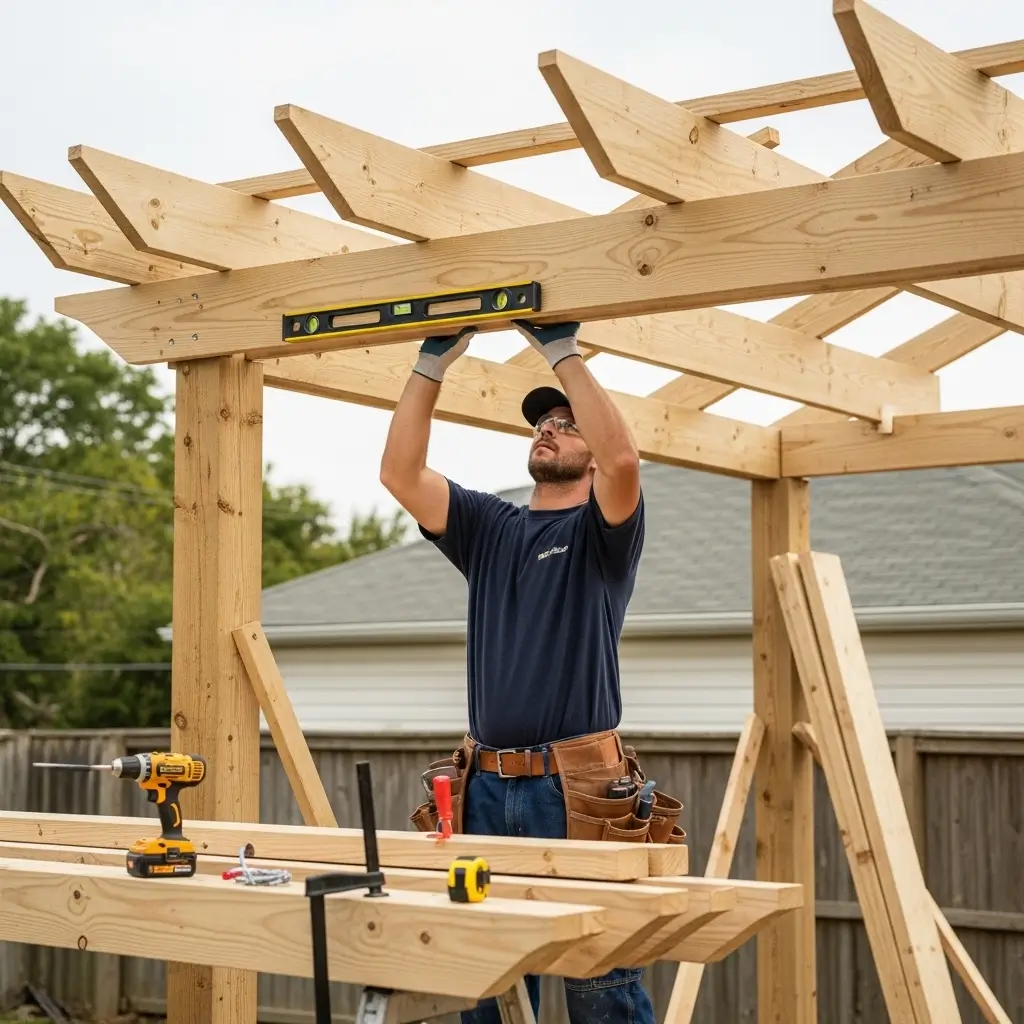
While a 2x6 might technically span 10 feet, it can look "spindly" on a large structure. Many builders choose to up-size to 2x8 or 2x10 lumber purely for visual weight and proportion, even if it exceeds the structural requirement.
Additionally, larger rafters allow for more decorative tail cuts (the shaped ends of the rafters), adding to the architectural style of your pergola.
2x4s are generally too small for main rafters unless the span is very short (under 6 feet) or they are used as top slats (purlins). 2x6 is the typical minimum for structural stability and visual appeal.
Yes. Cedar and Redwood are softer woods. While rot-resistant, they are not as strong structurally as Pressure Treated Pine or Douglas Fir, meaning they require shorter spans or larger board sizes.
Clear span is the horizontal distance between the inside faces of the supports (beams or posts). It does not include the overhang or the width of the beams themselves.
If both work structurally, 2x8 is cheaper, but 2x10 looks more robust on larger pergolas (over 12x12). For spans over 12 feet, 2x8 is often the minimum requirement, making 2x10 a safer choice.
For a pergola with no roof load (light load), a 2x6 can typically span 10 to 12 feet depending on the wood species and spacing. Adding a roof covering reduces this max span significantly.
Yes. Beams carry the weight of all the rafters. Beams usually need to be doubled up (e.g., two 2x8s or two 2x10s) and are often one size larger than the rafters for visual balance.
Yes. Wider spacing (e.g., 24" O.C.) puts more load on each individual rafter, often requiring a larger board size compared to tighter spacing (e.g., 12" O.C.).
Absolutely. Pressure treated Southern Yellow Pine is very strong and rot-resistant, making it ideal for structural parts. You can stain or paint it to look like cedar.
James D.
Carpenter
"Quick and easy. Matches the span tables I use on site."
Sarah M.
DIYer
"Saved me from buying the wrong lumber. Wish it had a cost estimator though."
David R.
Contractor
"Accurate recommendations. I always check this before buying materials."
Mike L.
First-time User
"A bit conservative on the spans, but better safe than sorry."
Emily R.
Architect
"Good for quick checks. The wood species factor is key."
James Lee
Estimator
"This tool was invaluable for my custom home project. The gauge price difference was clear to see."
We'd love to hear from you! If you have suggestions, questions, or just want to say hello, please get in touch.