Phone:
(701)814-6992
Physical address:
6296 Donnelly Plaza
Ratkeville, Bahamas.

Phone:
(701)814-6992
Physical address:
6296 Donnelly Plaza
Ratkeville, Bahamas.
Ensure structural integrity by calculating the correct beam size for your post spacing.
Clear distance between the supporting posts.
How long are the rafters resting on this beam?
Distance beam extends past the post.
Recommended Beam Size
(2) 2x10
Supports rafter load safely
Total Length
14'
Tributary Width
12'
Load Rating
Moderate
Est Weight
85 lbs
Your feedback helps us build better tools.
A Pergola Beam Span Calculator is a structural planning tool designed to determine the appropriate lumber size for the main horizontal supports (beams) of a pergola. Beams carry the weight of the rafters and transfer it to the posts. This calculator accounts for the distance between posts (span) and the load from the rafters to prevent dangerous sagging or structural failure.
Determine your support.
Input the clear span between your supporting posts. This is the gap the beam must bridge.
Input the length of the rafters that will rest on this beam. This determines how much weight the beam carries.
Choose your lumber species (Pine, Cedar, etc.) and whether you are using a single or double beam configuration.
Beam sizing is complex and depends on the "tributary width" (load area) and wood species strength. We use simplified span table logic for residential decks and pergolas.
Note: Always consult a structural engineer for spans over 14 feet or heavy roof loads.

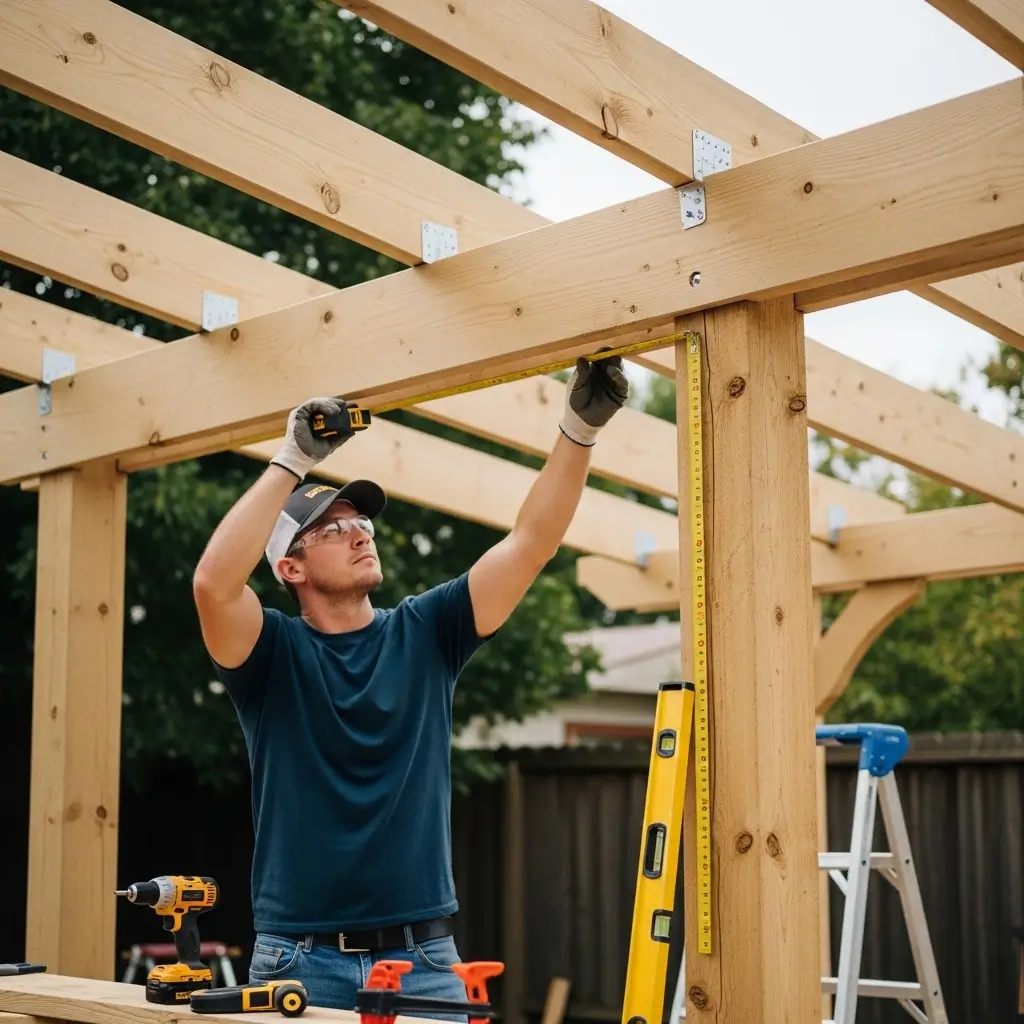
"Sandwich" Beams: Using two boards (e.g., two 2x8s) bolted on either side of the post is a classic pergola style. It's strong, easy to install, and looks great.
Solid Headers: A single large timber (e.g., 6x10) sitting on top of notched posts provides a heavy timber look but is much heavier to lift and harder to source.
For a standard pergola with light rafters (no heavy roof), a double 2x8 (Southern Pine) can typically span 10 to 12 feet between posts.
Double 2x6 beams are generally limited to short spans of 6 to 8 feet. For most 10x10 or 12x12 pergolas, 2x8 or larger is recommended for structural integrity and visual proportion.
Yes. Cedar is a softer wood. If calculating for Cedar, you typically need to reduce the maximum span by about 10-15% compared to Pressure Treated Southern Pine, or step up to the next beam size.
The cantilever is the portion of the beam that extends past the post. A general rule is the cantilever should not exceed 1/4 of the span between posts.
This calculator assumes a standard light load (open roof). If you have significant snow load or a solid roof, you should increase your beam size (e.g., from 2x8 to 2x10 or 2x12) or consult an engineer.
Typically, two 1/2" diameter carriage bolts are used to secure a double beam to a 6x6 post. Always check local building codes for fastener requirements.
The "span" is the distance between posts. The "total length" includes the overhangs. Ensure you buy lumber long enough for the span PLUS overhangs on both sides.
Splicing should always happen over a post, never in the middle of a span. For a double beam, stagger the splices so they don't both occur on the same post.
James D.
Carpenter
"This calculator confirms my span tables every time. Reliable."
Sarah M.
DIYer
"Nice app, simple to use. Helped me pick between 2x8 and 2x10."
David R.
Contractor
"Accurate logic. Matches my engineering handbook."
Mike L.
First-time User
"Ok, but I wish it supported 3-ply beams."
Emily R.
Architect
"Straightforward tool. Wish it had metric."
James Lee
Estimator
"Good for quick checks. The max height calculation is a good safety feature."