Phone:
(701)814-6992
Physical address:
6296 Donnelly Plaza
Ratkeville, Bahamas.
Phone:
(701)814-6992
Physical address:
6296 Donnelly Plaza
Ratkeville, Bahamas.
Calculate the perfect diagonal to ensure your corners are square.
Select a preset to auto-fill dimensions.
Required Diagonal (Hypotenuse)
5
Feet
Side A²
9
Side B²
16
Total (C²)
25
Your feedback helps us build better tools.
The 3-4-5 Rule Calculator is a construction utility based on the Pythagorean theorem. It helps builders verify that corners are perfectly square (90 degrees). If one side of a triangle is 3 units and the other is 4 units, the diagonal connecting them must be 5 units for the corner to be square. This ratio works for any multiple (e.g., 6-8-10, 9-12-15), making it scalable for any project size.
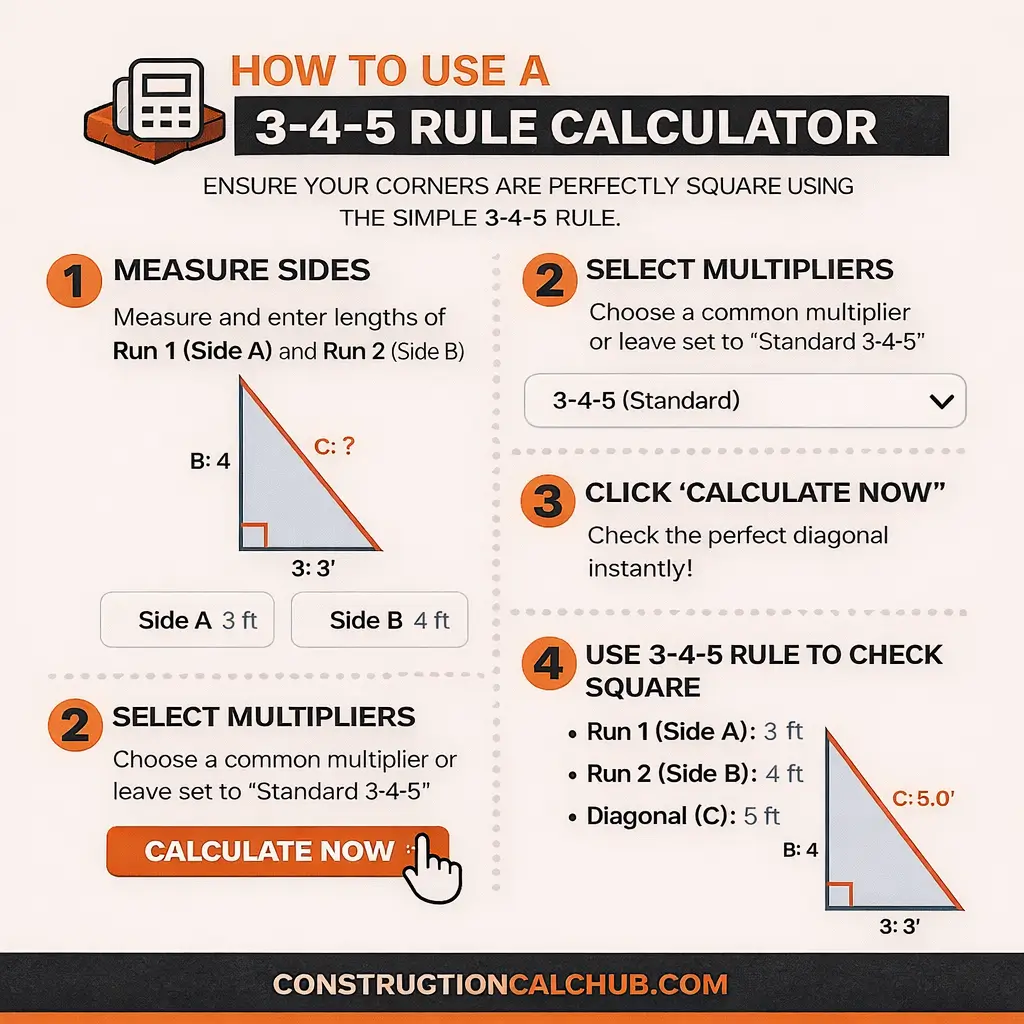
Follow these simple steps to ensure your corners are perfectly square:
Measure and check.
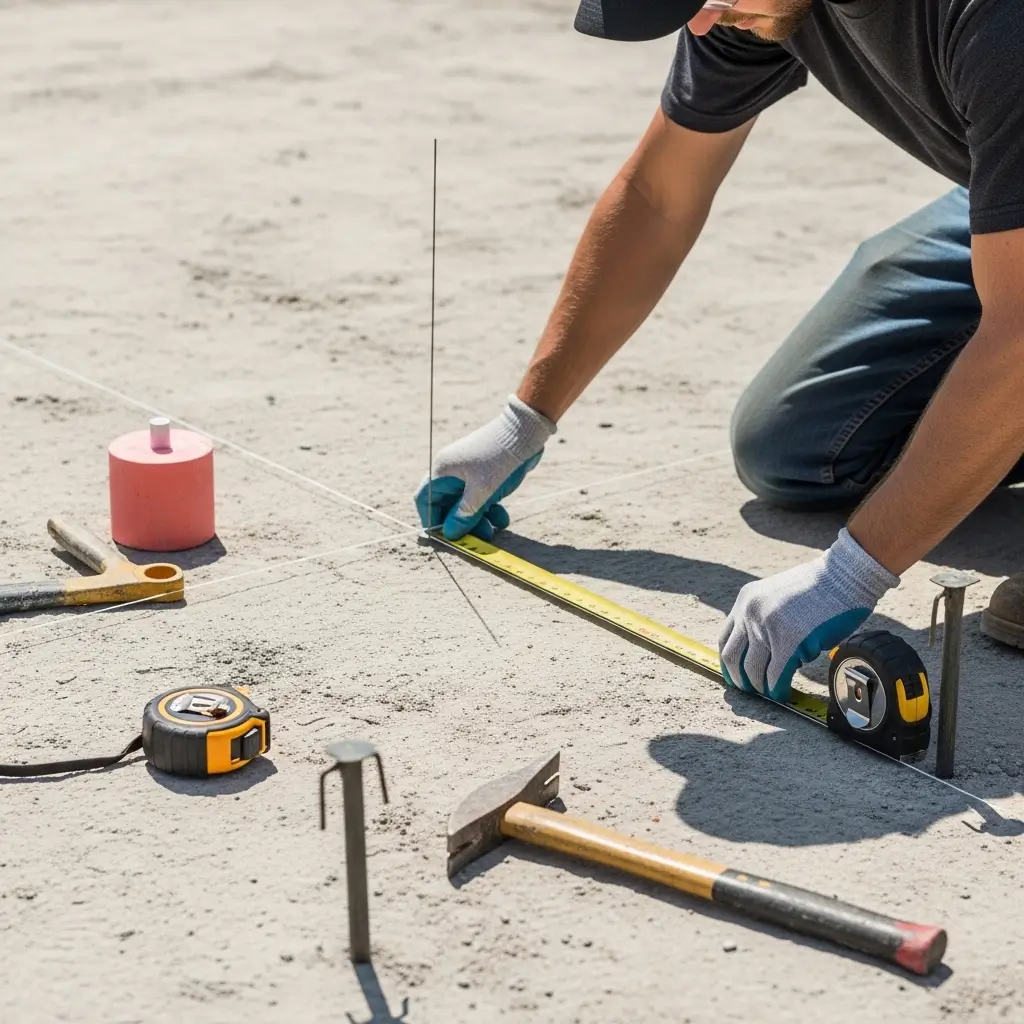
Measure 3 feet (or any multiple) along one wall from the corner and mark it.
Measure 4 feet (or corresponding multiple) along the adjacent wall and mark it.
Measure the distance between the two marks. If it matches the calculated diagonal (e.g., 5 ft), the corner is square.
The rule is based on the Pythagorean theorem: $a^2 + b^2 = c^2$.
This ensures that the angle between Side A and Side B is exactly 90 degrees.
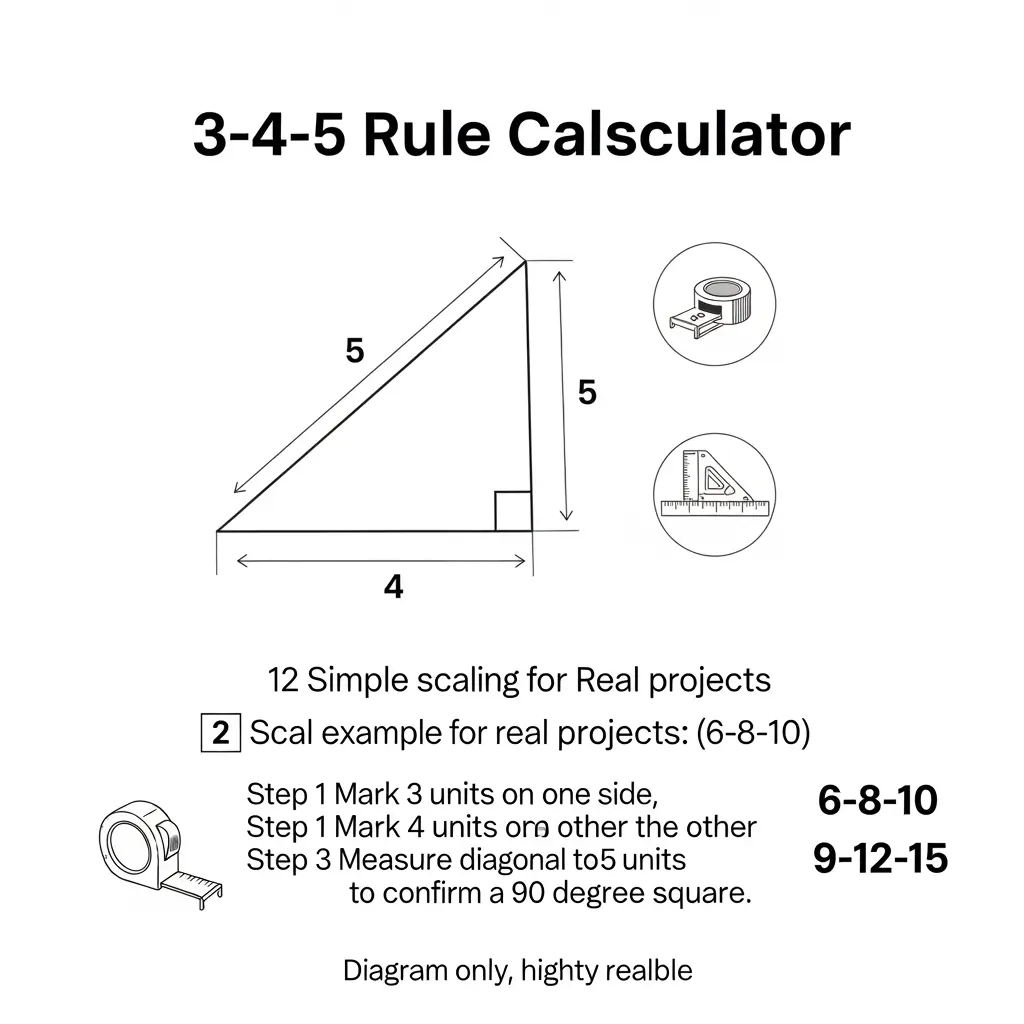
While 3-4-5 is easy to remember, it might be too small for large layouts like decks or foundations. Using larger multiples like 6-8-10, 9-12-15, or even 12-16-20 increases accuracy over long distances.
The larger the triangle you measure, the more precise your square corner will be, reducing the margin of error in your construction project.
It is a method used by carpenters and builders to check if a corner is square (90 degrees). By measuring 3 units on one side, 4 on the other, the diagonal connecting them should be exactly 5 units.
Yes! The 3-4-5 rule works with any unit of measurement (feet, inches, meters, centimeters), as long as you stick to the same unit for all three sides.
If your diagonal is shorter than calculated, your angle is less than 90° (acute). If it is longer, your angle is greater than 90° (obtuse). Adjust your corner until the diagonal matches.
Yes, 6-8-10 is just the 3-4-5 rule multiplied by 2. Using larger numbers helps improve accuracy over larger distances.
Yes, but use the largest multiple possible (e.g., 12-16-20 or 15-20-25) to minimize measurement error over long spans.
Measure from the corner of the house along the ledger board for one side, and along the rim joist for the other. Use the calculator to find the diagonal and adjust the rim joist until it matches.
If the diagonal doesn't match, your corner isn't 90 degrees. You need to shift the free end of your framing left or right until the diagonal measurement matches the calculator's result.
Yes! 5-12-13 is another "Pythagorean Triple" that works perfectly for right angles. You can enter 5 and 12 into the calculator to confirm the diagonal is 13.
James Davis
Carpenter
"Simple and perfect. Exactly what I needed to square up my foundation."
Sarah Mitchell
DIYer
"Saved my deck layout. The pre-sets for larger triangles are super handy."
David Robinson
Contractor
"Good visual, wish it had a metric toggle for cm."
Mike Larson
First-time User
"Basic Pythagoras, nothing fancy. Works as advertised."
Emily Reynolds
Architect
"Essential for framing. Use it on every foundation pour."
James Lee
Estimator
"Works well."
We'd love to hear from you! If you have suggestions, questions, or just want to say hello, please get in touch.